

AI evolves weekly. Every week, there’s an announcement for a new model, disrupted industry, or automated job category.
Businesses evolve over years. They plan quarters ahead for innovation and transformation.
Business that do not accelerate their evolution to keep pace with AI will die.
The Engine That Powers Evolution
Businesses evolve by learning. They cannot evolve faster than they can learn. Learning is the rate-limiting input. If learning slows, evolution slows, and competitive advantage erodes. A company’s learning velocity is therefore the leading indicator of its future competitive position.
Currently, businesses learn how to do new things primarily through two activities:
Innovation = Go from zero to one, from nothing to something.
Transformation = Restructure what the business does and how it does it.
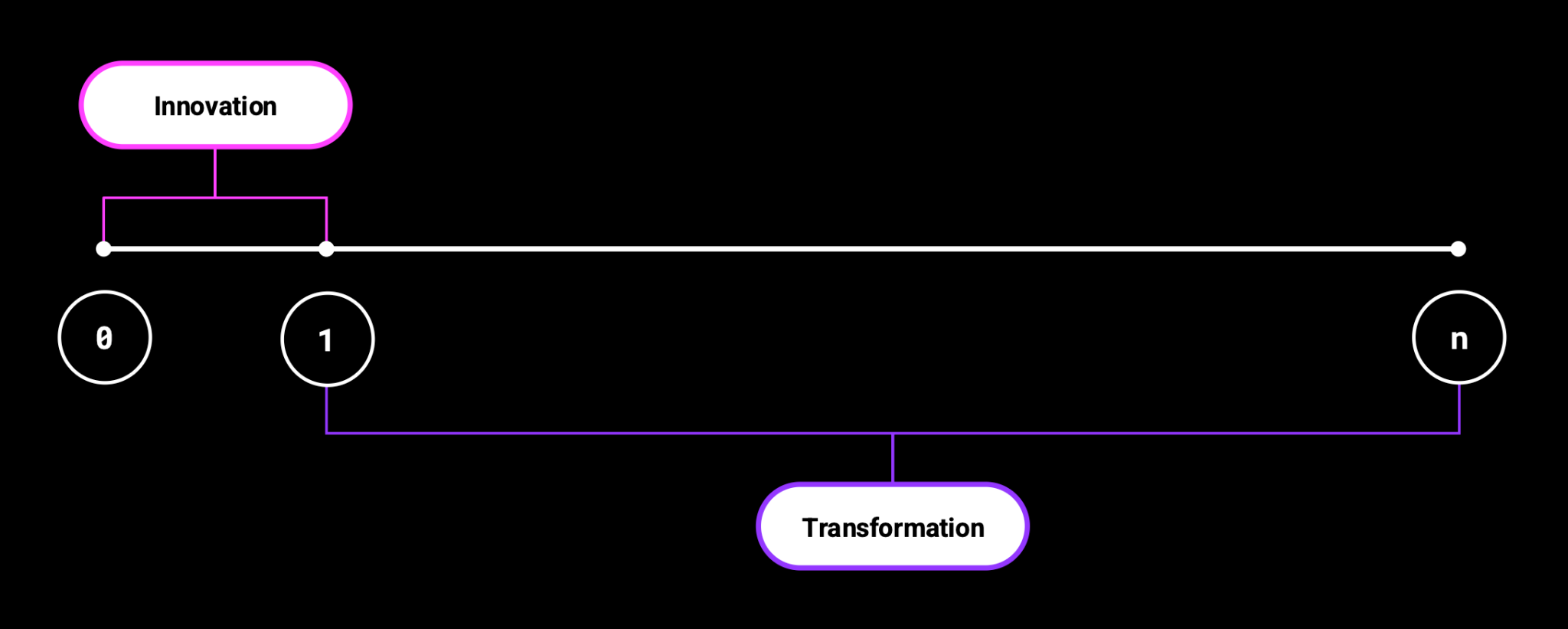
Both of these processes imply a start and end date. They are inherently time bound endeavors.
AI’s evolution is unbounded. It will evolve until it automates many industries. Therefore, businesses need to learn to continuously evolve too.
Business Evolution is the process by which the characteristics of businesses change over time, new types of businesses develop, and others disappear. This has always happened; now it will happen at hyper-speed.
Why Evolution Is the Only Durable Advantage
The company that evolves fastest wins, because every other advantage decays. There Is No Steady State
AI’s frontier is moving forward far and fast. It collapses the cost and time of completing tasks, capabilities, products, and processes. It commoditizes software, so it is easier and faster to build things than to buy them.
Either a company learns to evolve, or it stagnates. There is no third option. In a changing environment, standing still is moving backward relative to those powered by AI.
How Evolution Stays Productive Rather Than Random
The operational discipline that keeps evolution from becoming chaos is Amazon’s working-backwards model: start with the customer and work backwards using data.
Without a customer anchor, evolution becomes thrash. The customer is the fixed point. Data is the navigation tool. Every evolution decision starts with a real customer need and reasons backward to what the business must build, change, or scale. As AI makes it cheap to build the wrong thing fast, this discipline matters more than ever.
Why Most Companies Cannot Do This
Now we need to look at why this is so hard for most companies, and what they have to change.
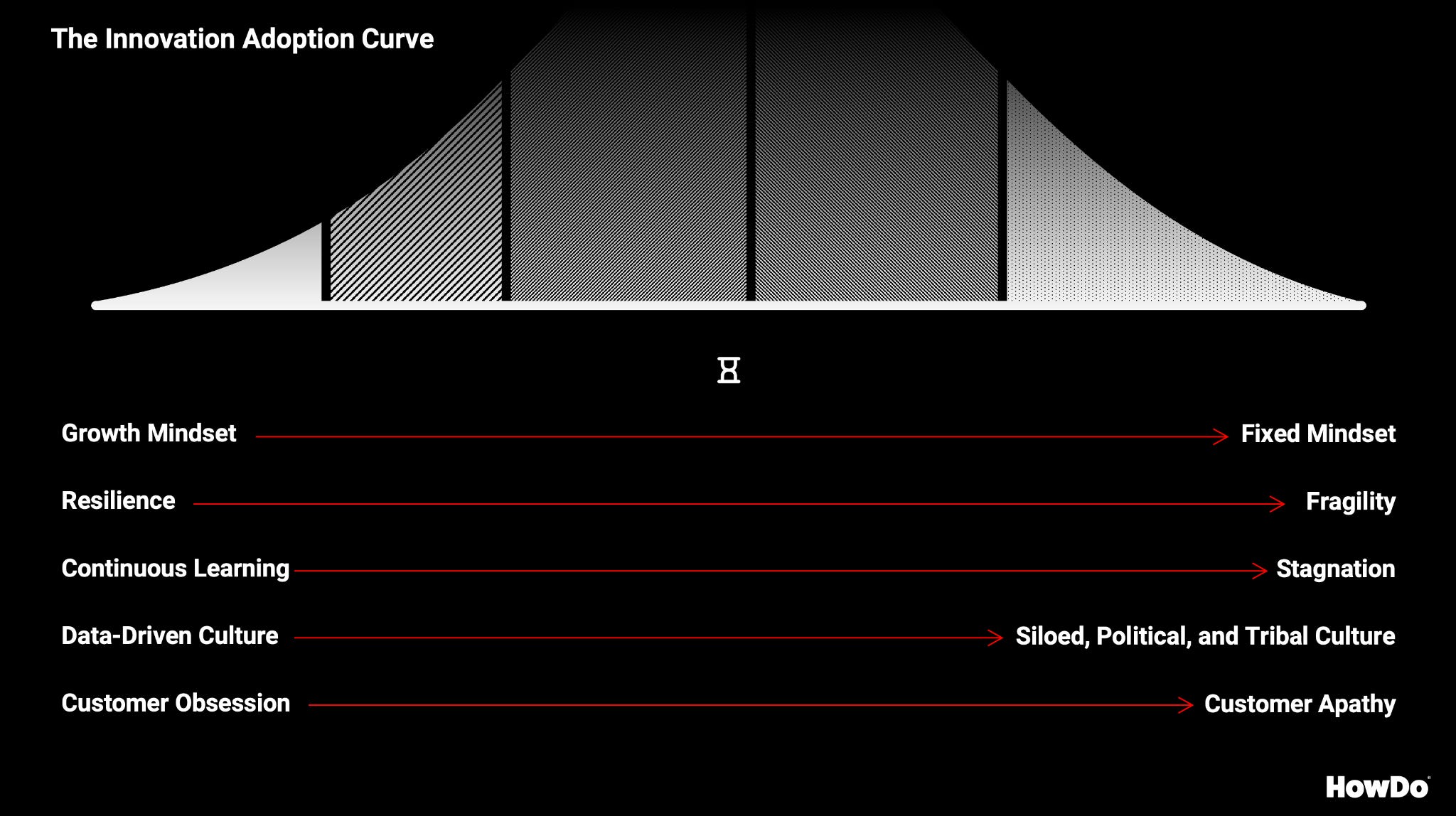
The classic Rogers diffusion curve segments any population into five groups by their relationship to new ideas:
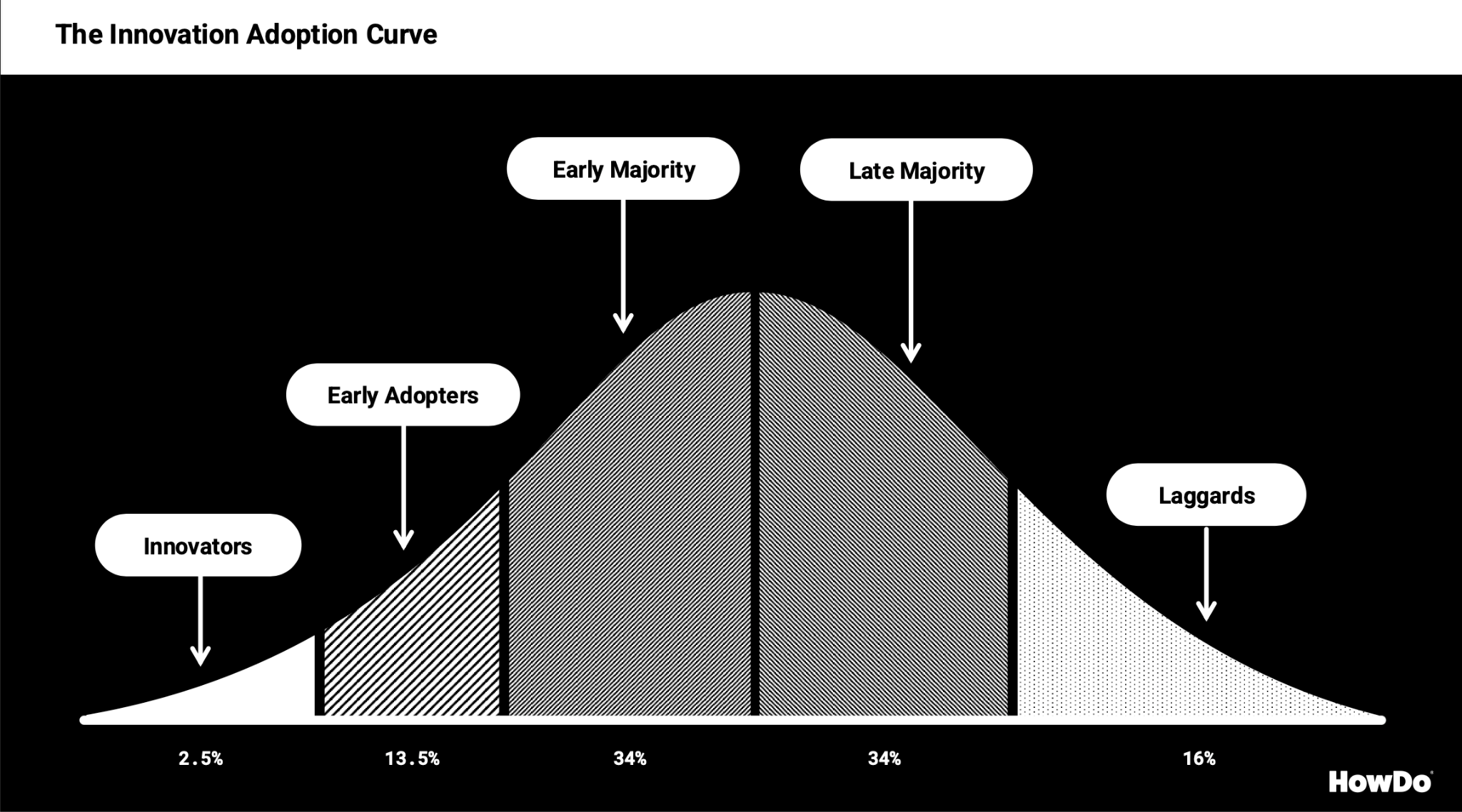
Innovators (2.5%) create the new
Early Adopters (13.5%) take risks on the new
Early Majority (34%) adopt once it is proven
Late Majority (34%) adopt once it is standard
Laggards (16%) adopt only when forced
This curve is usually used to describe customers. But it also describes companies. Whole organizations sit somewhere on this curve based on their relationship to change.
For chance, we bucket the curve into three behavioral zones:
Change Frequently, where Innovators and Early Adopters live
Change Infrequently, where the Early and Late Majority live
Rarely Change, where Laggards live
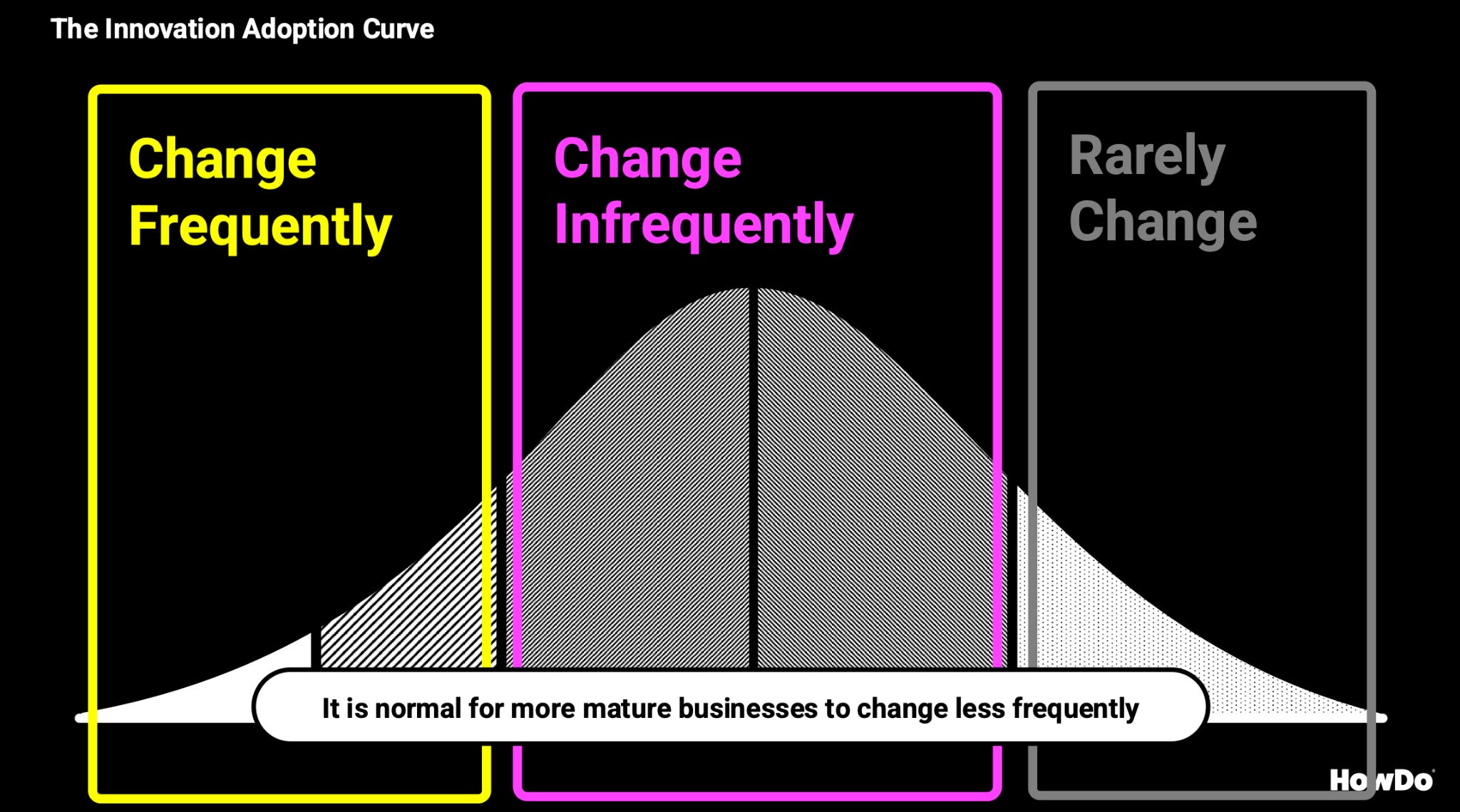
Over time, mature businesses naturally drift right. It is normal for a company that has scaled, optimized, and stabilized to find itself in the Change Infrequently or Rarely Change zone. Stability is the reward for past success, and stability resists change.
The further right a company sits, the more allergic to change its culture becomes, and the less capable it is of evolution. Companies on the left enjoy change. Companies in the middle tolerate it with discomfort. Companies on the right hate it.
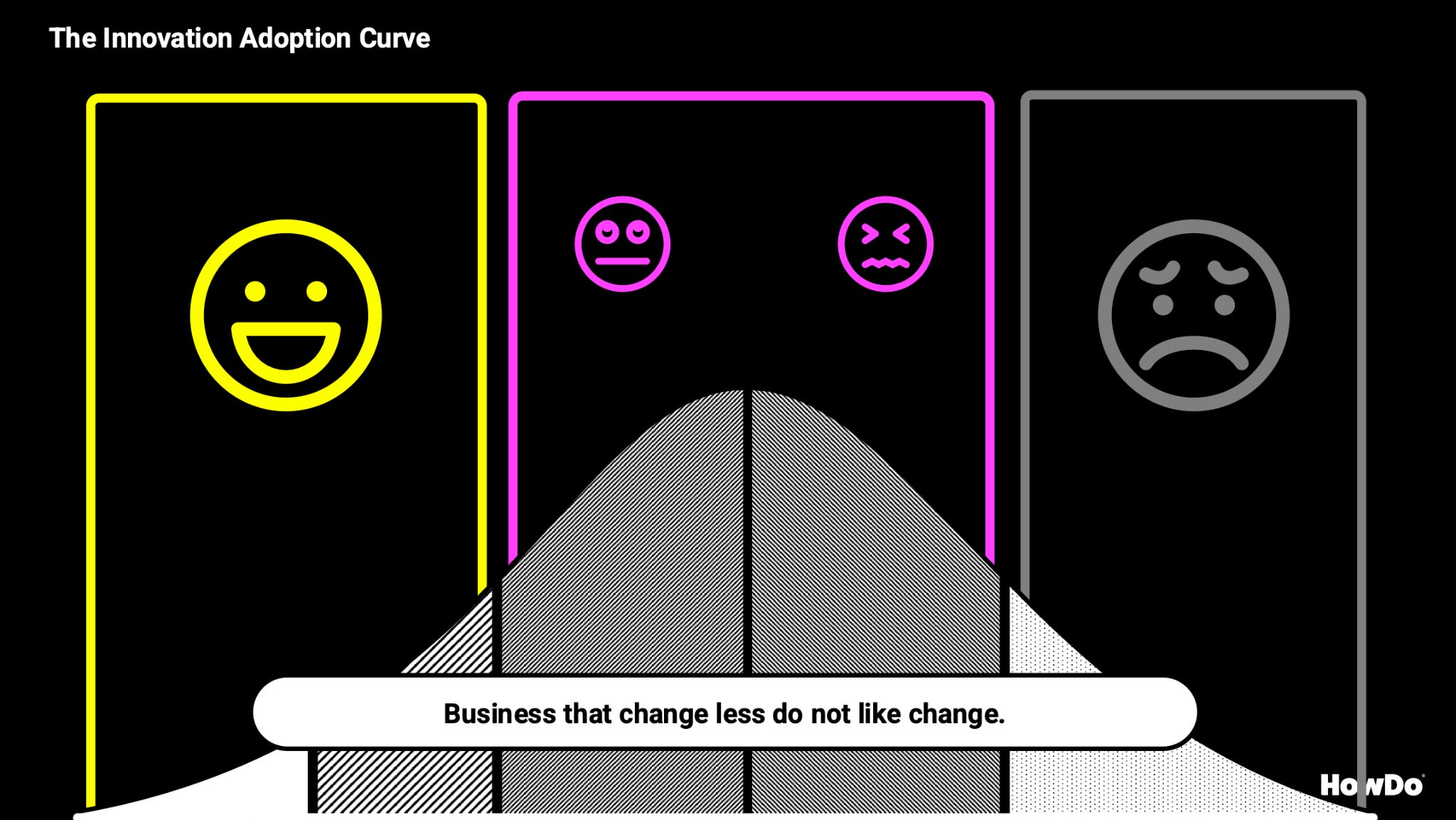
AI is now the most aggressive force pulling on every company’s position. Companies on the left absorb AI as augmentation. Companies on the right experience it as existential threat.
What Determines Where a Company Sits
Five cultural attributes determine a company’s position on this curve and its capacity to evolve in the AI era. These are durable cultural drifts; they existed before AI and will exist after. Maturity pulls them rightward by default; the work is to reverse the drift.
Five Cultural Drifts to Reverse
Each is a spectrum. The left pole is the culture of a company that evolves. The right pole is the culture of a company that stagnates:
Resilience to Fragility
Growth Mindset to Fixed Mindset
Continuous Learning to Stagnation
Data-Driven Culture to Siloed, Political, and Tribal Culture
Customer Obsession to Customer Apathy
As a business matures, time itself pulls the culture rightward on all five dimensions simultaneously. This is the cultural drift. It happens by default. It does not require bad leadership or bad people. It requires only the passage of time and the natural human preference for predictability over disruption.
The Job of Leadership
The job of leadership is to reverse the drift on all five universal dimensions to allow their business to thrive.
A growth mindset without continuous learning is just optimism. Customer obsession without data is just opinion. Resilience without a growth mindset is just stubbornness. The five must move together, deliberately, against the gravitational pull of organizational maturity and against the disruption of an AI-saturated workplace.
The Five in Detail
1. From Fragility to Resilience
Resilience is the capacity to absorb shocks, recover from failure, and keep moving. Fragility is the opposite: small disturbances cause large damage, and recovery is slow or impossible. A company that cannot absorb the failure of an experiment cannot run experiments. A company that cannot run experiments cannot innovate. In the AI era, capability releases, workflow shifts, and identity disruption arrive at high frequency. Resilient cultures absorb these waves; fragile ones fracture.
Resilience is the foundation. The other dimensions sit on top of it. Without resilience, no other cultural change holds.
2. From Fixed Mindset to Growth Mindset
A growth mindset is the belief that abilities and intelligence can be developed through effort, learning, and persistence. A fixed mindset is the belief that they are static traits that cannot be significantly changed.
Reversing toward growth mindset requires balancing short-term quarterly delivery with long-term strategic delivery, emphasizing exploration and experimentation over efficiency and optimization, eliminating organizational debt in the form of rigid processes and norms, and shifting leadership focus from stability and execution to growth and learning.
AI raises the stakes: it continuously redefines the skills the company needs, and a fixed-mindset culture treats that redefinition as a personal threat rather than a learning opportunity.
3. From Stagnation to Continuous Learning
Continuous learning is an ongoing commitment to acquiring new knowledge, skills, and insights, and applying them to improve products, processes, and outcomes. Stagnation is a lack of growth or improvement over time, often due to a failure to learn, adapt, or evolve.
Reversing toward continuous learning requires making learning a strategic priority rather than an HR program, balancing exploitation of current capabilities with exploration of new ones, replacing conformity and risk avoidance with curiosity and experimentation, and replacing siloed and political knowledge with shared and collaborative knowledge.
AI raises both the floor and the ceiling: stagnant organizations fall further behind every quarter, while learning organizations compound their lead.
4. From Siloed, Political, and Tribal Culture to Data-Driven Culture
A data-driven culture values and relies on empirical evidence, metrics, and analytics to inform choices, strategies, and operations at all levels. A siloed, political, and tribal culture relies on localized, subjective, politically influenced knowledge, opinions, and experiences to inform decisions within isolated groups.
Reversing toward a data-driven culture requires eliminating competing agendas built on personal and tribal interests, distributing customer and performance data widely so legacy beliefs can be tested against reality, mandating curiosity and collaboration rather than tolerating silos, and simplifying organizational complexity to reduce communication and trust barriers.
AI is fundamentally a data system: data-driven cultures unlock its full value, while political cultures use AI to confirm preconceptions and ignore inconvenient outputs.
5. From Customer Apathy to Customer Obsession
Customer obsession means the company is organized around the customer at every level. Customer apathy means the company is organized around itself, its politics, and its internal priorities, with the customer as an afterthought.
Reversing toward customer obsession requires shrinking the distance between the organization and its customers, aligning internal priorities and metrics on customer outcomes, emphasizing customer research, feedback, and co-creation, and shifting culture from efficiency and standardization to empathy and service.
AI deepens this focus: customer-obsessed cultures will use AI to anticipate and serve at unprecedented depth and personalization.
The Through-Line
Business success is evolution. Evolution is innovation plus transformation, anchored to the customer and powered by learning. Every business that achieves scale begins to drift culturally to the right on five dimensions, becoming more fragile, more fixed, more stagnant, more siloed, and more inwardly focused. This drift is the default. It is the price of maturity.
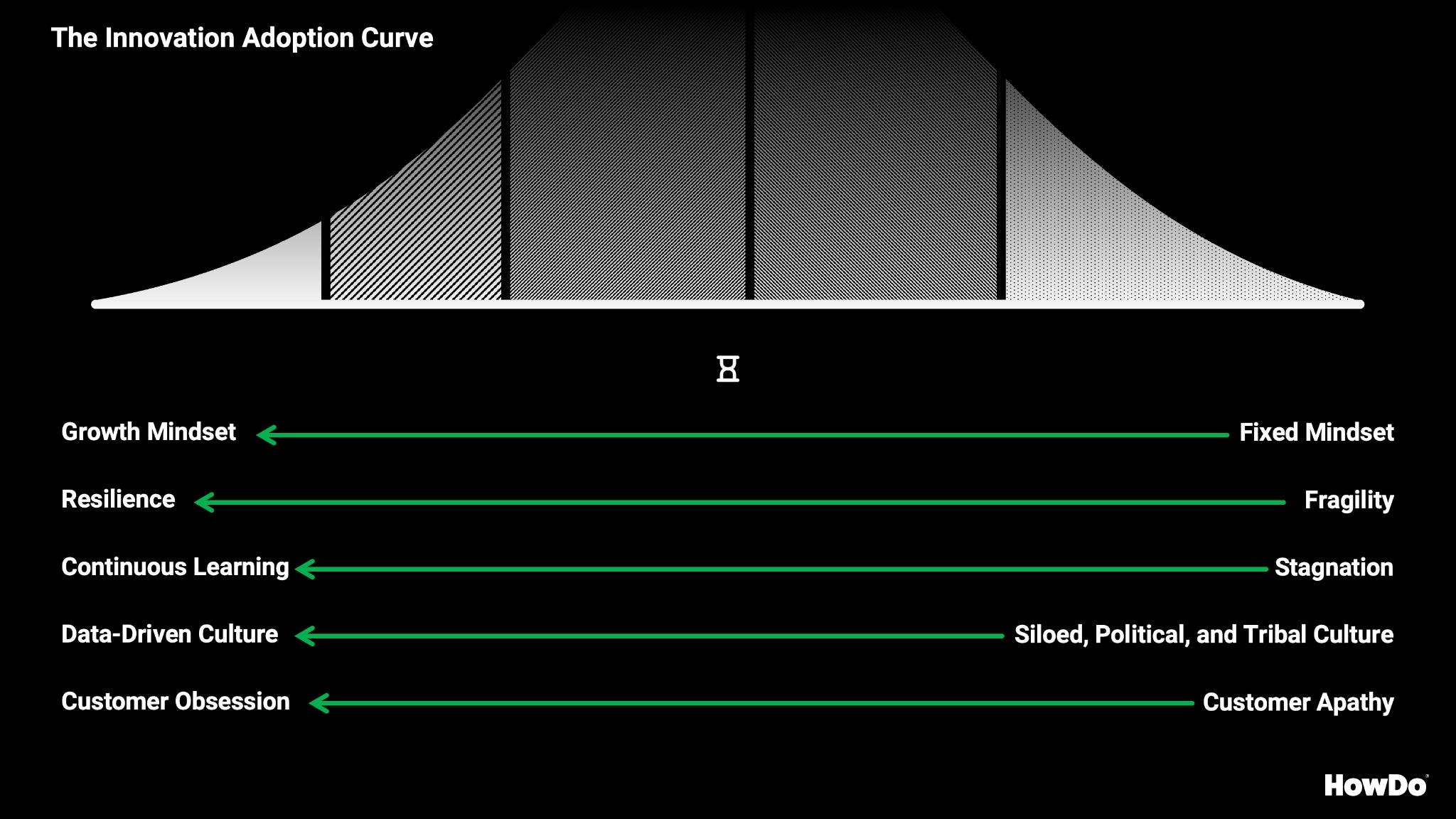
The job of leadership is to actively reverse the drift on the five. Without these five, the business stagnates and AI becomes a procurement line item that never produces returns.
With them, the business evolves and AI becomes the most powerful augmentation tool in the company’s history.
What AI Asks of Every Company
Evolve or die.
If you want your business to evolve, follow me.