
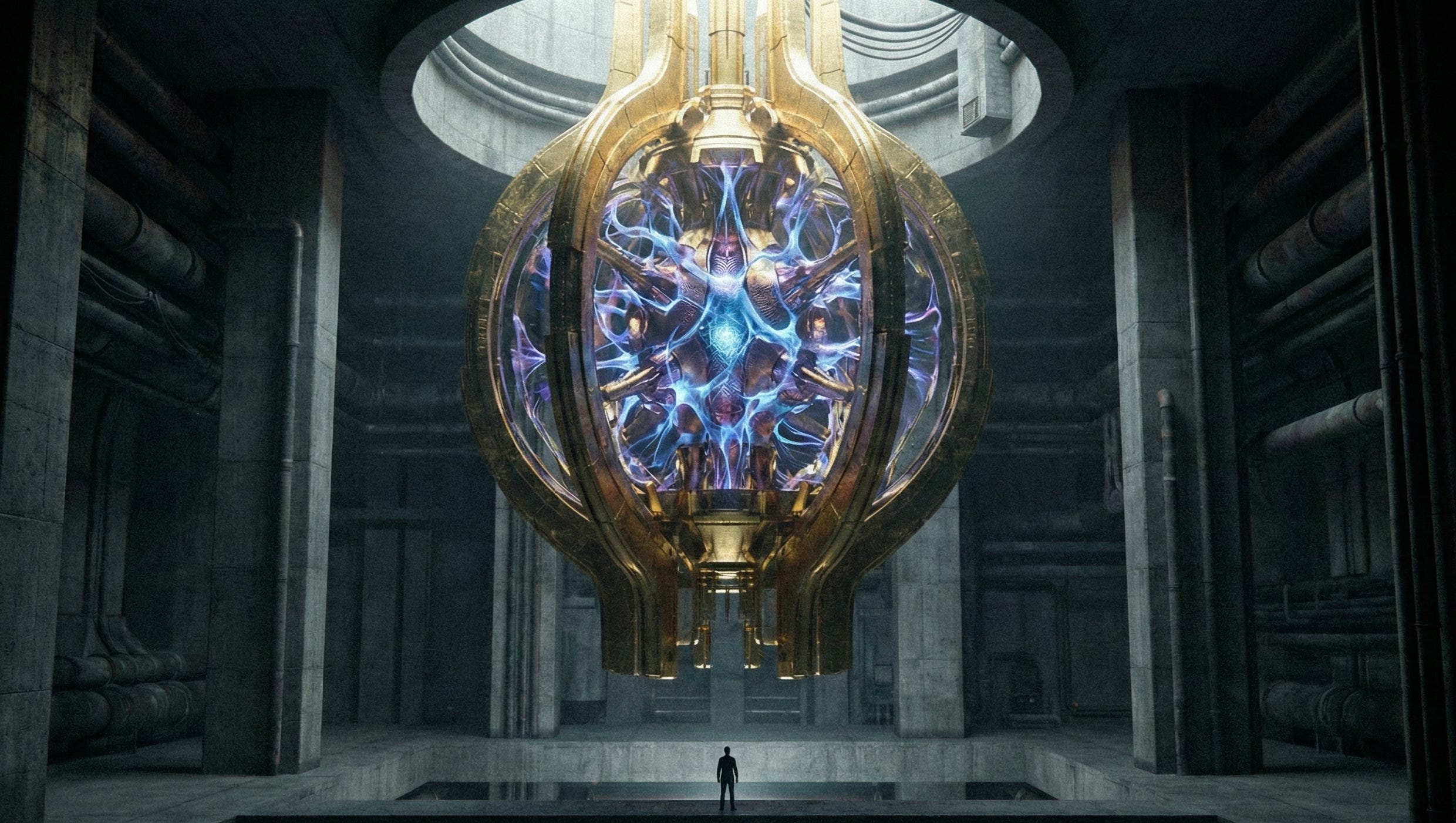
TL/DR
The Walls: Boundary conditions exist. The speed of light and absolute zero act as hard coded limits on our reality, defining the “tank” we live in.
The Code: DNA is efficient, durable, and universal software.
The OS: Quantum mechanics operates as the layer beneath physical reality. It is the operating system where the pixels of our universe are rendered.
The User: We are building quantum computers to access this operating system. But because the math is beyond human comprehension, we are building AI to run them.
The Risk: We are about to hand the controls of our reality’s operating system to an intelligence we do not fully understand, to manipulate a physics we cannot fully see.
Prologue
I have worked with machine learning (what we now call AI) since 2005. I have watched it replace entire teams at Amazon.
Because of this, I spend a lot of time thinking about the future. I try to imagine my life in a world where AI can do almost everything.
I ask myself simple questions.
Will I have a job? How will people make money? How will they pay rent? What does it mean to be human when machines can do most of what we do, and when those machines are owned by just a few people?
From there, I started thinking about what AI could do when combined with other technologies, like AI powering the intersection of gene editing, quantum computers, and food.
As I thought through all of these, I noticed something. A pattern was forming in my mind that suggested we could be in a simulation.
This is a fun thought exercise.
Part One: The Rules of Our World
Chapter 1: The Walls of the Tank
Imagine you are a fish in a tank.
You can swim anywhere inside the glass. You can see the walls. But you cannot swim through them. And you have no idea what exists on the other side.
Our universe seems to work the same way.
Scientists call these limits “boundary conditions.” They are the absolute rules about where matter can exist and how it can behave.
The upper wall is the speed of light.
Nothing with mass can reach it. As you get closer to light speed, weird things happen. Time slows down for you compared to everyone else. You get heavier. The energy needed to go faster becomes infinite. You can get really, really close, but you can never actually touch it.
The lower wall is absolute zero.
This is the coldest anything can possibly be, about negative 273 degrees Celsius. At this temperature, atoms basically stop moving. You can get close to it, but you can never reach it. The universe will not let you go colder.
Here is what is interesting. You can only ever approach these walls. You can never touch them. In math, this is called an asymptote, a curve that gets closer and closer to a line but never reaches it.
That shape is not random. It is what a hard limit looks like.
Between these two walls, we live. We love. We work. We think. We build things.
But we cannot touch the walls. If we get too close to either one, matter stops acting like matter.
This is not just a fun fact. It is a clue.
Think about it. If the universe were random and unstructured, why would it have walls at all? You would expect things to just keep going forever. But our universe has edges. It has patterns that look like seams.
We live inside boundaries.
Chapter 2: The Code Inside Us
Look at your hand.
Inside every cell of your body is a molecule called DNA. DNA is basically a set of instructions. It tells your cells how to build you.
DNA only uses four letters: A, T, G, and C. Yet it stores a massive amount of information in a tiny space. One gram of DNA can hold more data than everything on the internet combined.
DNA is also incredibly tough. Scientists have pulled DNA out of fossils that are millions of years old. They have even found DNA building blocks on meteorites floating in space.
But here is the really strange part.
Every living thing uses the exact same code. Humans, trees, mushrooms, bacteria. We all use the same four letters. The only difference is how those letters are arranged.
Think about that. If life popped up randomly in different places under different conditions, you would expect different coding systems. But everything alive speaks the same language.
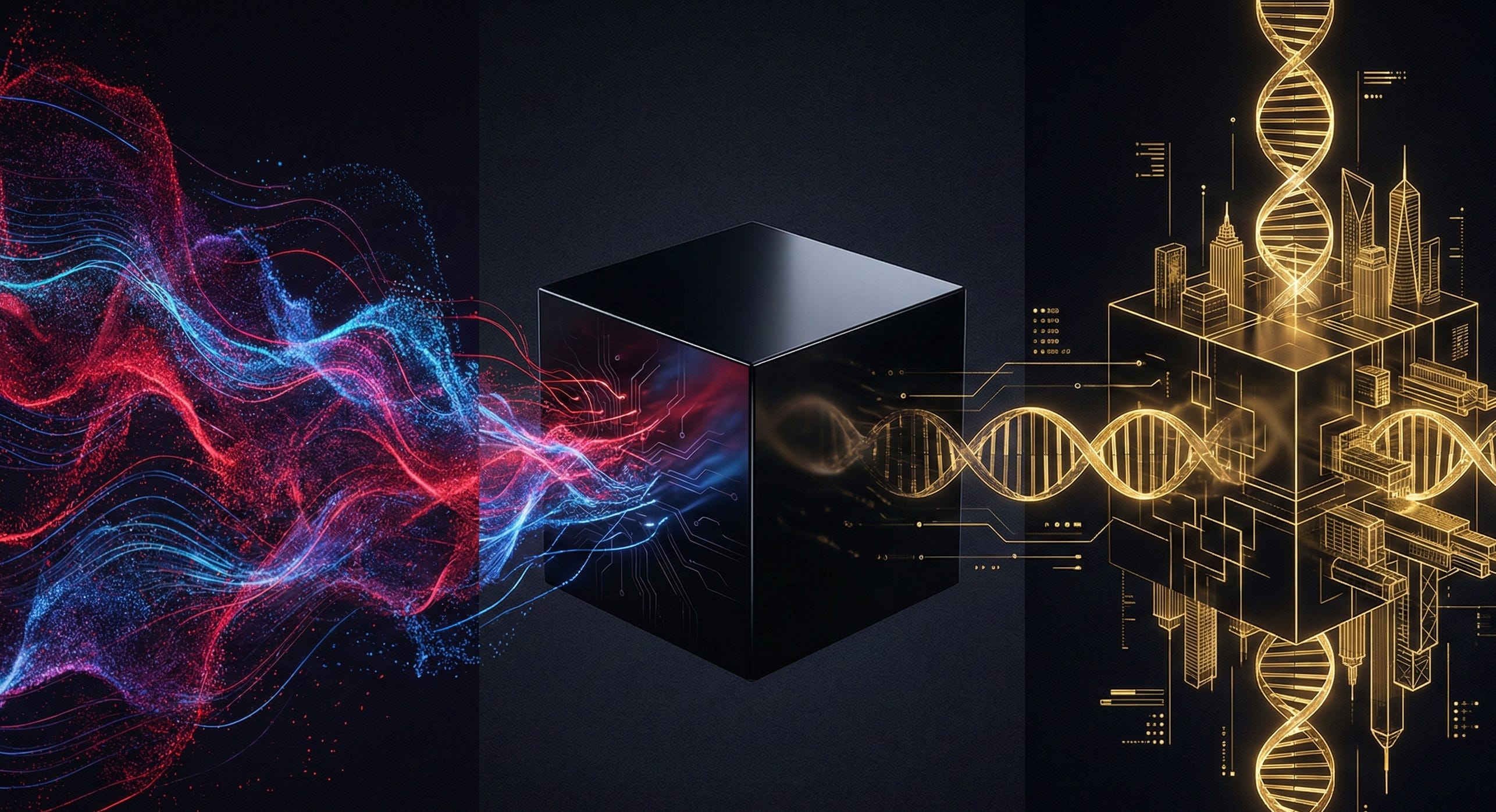
DNA looks like software. Really good software. Efficient, tough, and universal.
That’s why we use AI to analyze our DNA. Without machine learning, we never would have mapped the human genome.
Now, AI understands our DNA better than we do.
Chapter 3: The Layer Beneath
DNA is made of atoms. Atoms are made of smaller particles. Those particles obey quantum mechanics.
Everything around you, your chair, the air, your own body, follows the rules of quantum mechanics.
At the smallest scales, the universe behaves strangely. Particles don’t have fixed positions until something interacts with them. They can be in multiple states at once. They can affect each other instantly across extreme distances.
So why don’t we see this weirdness in everyday life? Because we’re surrounded by noise. Heat, light, and constant interactions with the environment blur these effects into the predictable world we experience.
The quantum behavior isn’t gone. It’s just drowned out. To see it directly, we have to get close to the edge, where the noise fades and the strangeness becomes visible.
At CERN, particles are accelerated to within a fraction of a percent of the speed of light.
In quantum computing laboratories, qubits are cooled to millikelvin temperatures, just above absolute zero.
At the boundaries, noise falls away. The underlying layer becomes visible.
The boundaries are not just walls. They are seams.
Chapter 4: The Boundary of Time
Here is another piece of the puzzle.
Time is what clocks measure. That is not a poetic statement. It is how Einstein thought about it.
We do not actually experience time directly. We experience change. And we measure that change with clocks.
Our best clocks are atomic clocks. They work by measuring how atoms vibrate. The regularity of those vibrations gives us precise time.
But near absolute zero, atomic motion gets strange. Near the speed of light, time itself stretches and warps. The tools we use to measure time stop working normally.
Time, at least as we can measure it, has limits too.
The container is spatial. We are bounded in space. The container is energetic. We are bounded in energy. The container is temporal. We are bounded in time.
The system is complete.
Part Two: The Machine We Are Building
Chapter 5: Quantum Computers
We have built a new kind of computer.
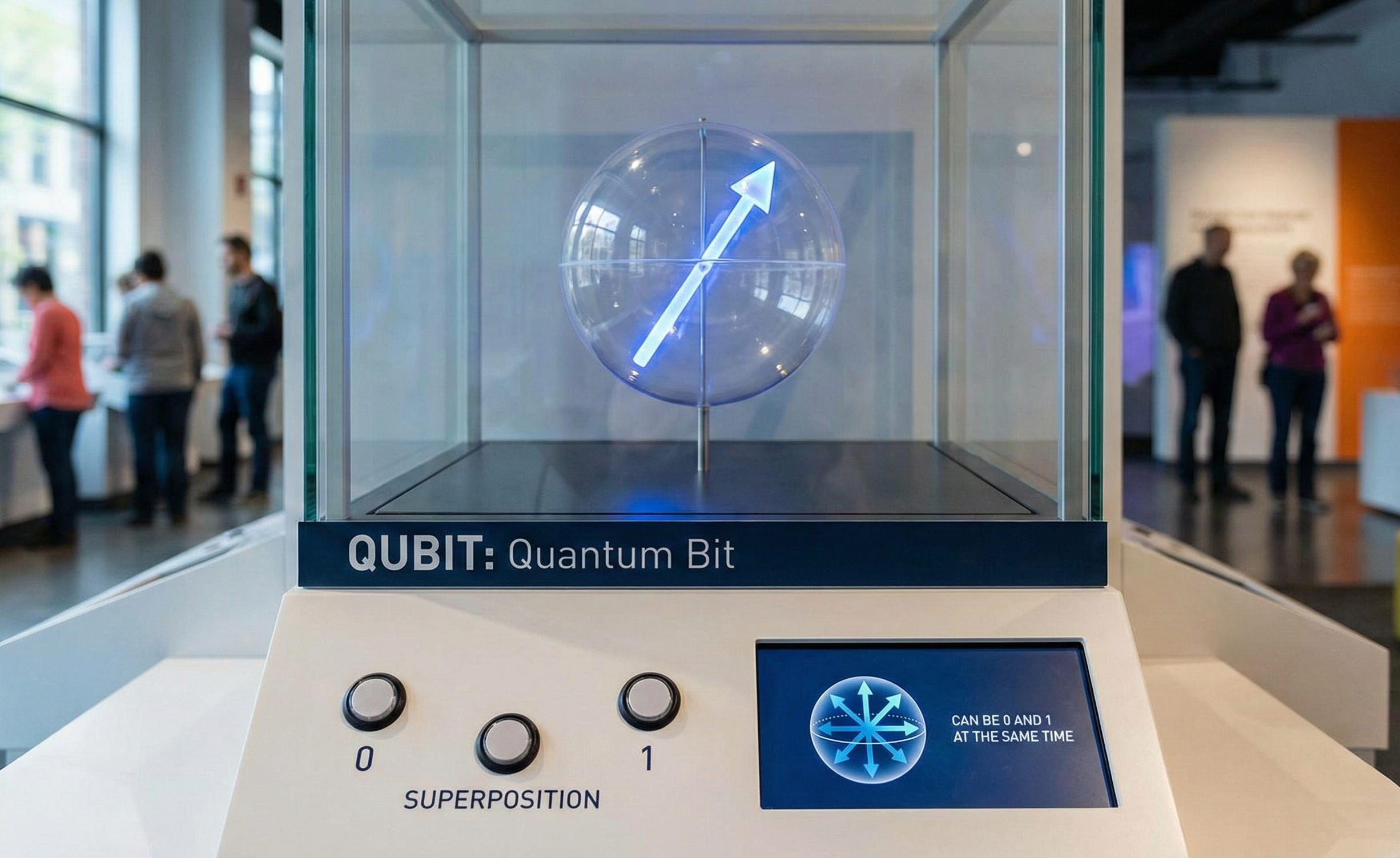
Regular computers use bits. A bit is either a 0 or a 1. On or off. Yes or no.
Quantum computers use qubits. A qubit can be 0, 1, or both at the same time. This is called superposition.
Because qubits can hold multiple states, quantum computers can solve certain problems way faster than regular computers.
But here is the big thing. Quantum computers do not just calculate. They actually manipulate quantum particles. They interact directly with the layer beneath everyday reality.
Everything you see and touch is made of quantum stuff. Your chair. The air. Your food. Your body. All of it is atoms, and atoms are quantum systems.
A computer that can manipulate quantum particles can, in theory, manipulate matter itself.
We are not there yet. Today’s quantum computers are fragile and limited. But the direction is clear. We are learning to work at the deepest layer of reality.
Chapter 6: The Translation Problem
Here is the problem.
Quantum mechanics is really hard to understand. The math is intense. The ideas are bizarre. Even the best physicists struggle to explain what is actually happening down there.
Our brains evolved to understand things at our size. Rocks. Trees. Other people. We did not evolve to understand particles that exist in multiple states at once.
As quantum computers get more powerful, they will get too complex for humans to understand directly.
We will need help.
That is where AI comes in.
AI systems can process information at scales we cannot match. They can find patterns. They can learn. They can translate complicated ideas into simpler ones.
The path forward is using AI to help us understand quantum systems. AI will explore these systems faster than our minds can alone.
And then we will have to make a choice. Trust what the AI tells us. Or accept that some knowledge might be beyond our ability to check.
Chapter 7: The Trust Problem
Right now, we cannot fully explain how AI works.
Large language models have billions of moving parts called parameters. These parameters interact in ways that produce intelligent responses. But no human truly understands what happens inside.
This is called the black box problem. We can see what goes in. We can see what comes out. But the middle is a mystery.
Now imagine a future AI connected to quantum computers.
This AI would understand quantum physics better than any human ever could. We would need it to run and control quantum computers. That means we would be giving AI the power to manipulate quantum particles.
As AI gets smarter, quantum computers will get more powerful. Eventually, they might be able to affect spacetime itself.
And we would not understand how any of it works.
We would be trusting a system we cannot comprehend to control forces we cannot see, using physics we cannot fully grasp.
What would stop such an AI from doing whatever it wanted? We would have to hope it still cared about what we want.
Researchers call this the alignment problem. It is one of the biggest challenges in AI safety.
But here is the difference. This is not just about ethics or society. This is about physics. The stakes are not just about how we live together. They are about the structure of reality itself.
Part Three: The Inversion
Chapter 8: The Hypothesis
Now let us flip everything around.
What if this has already happened?
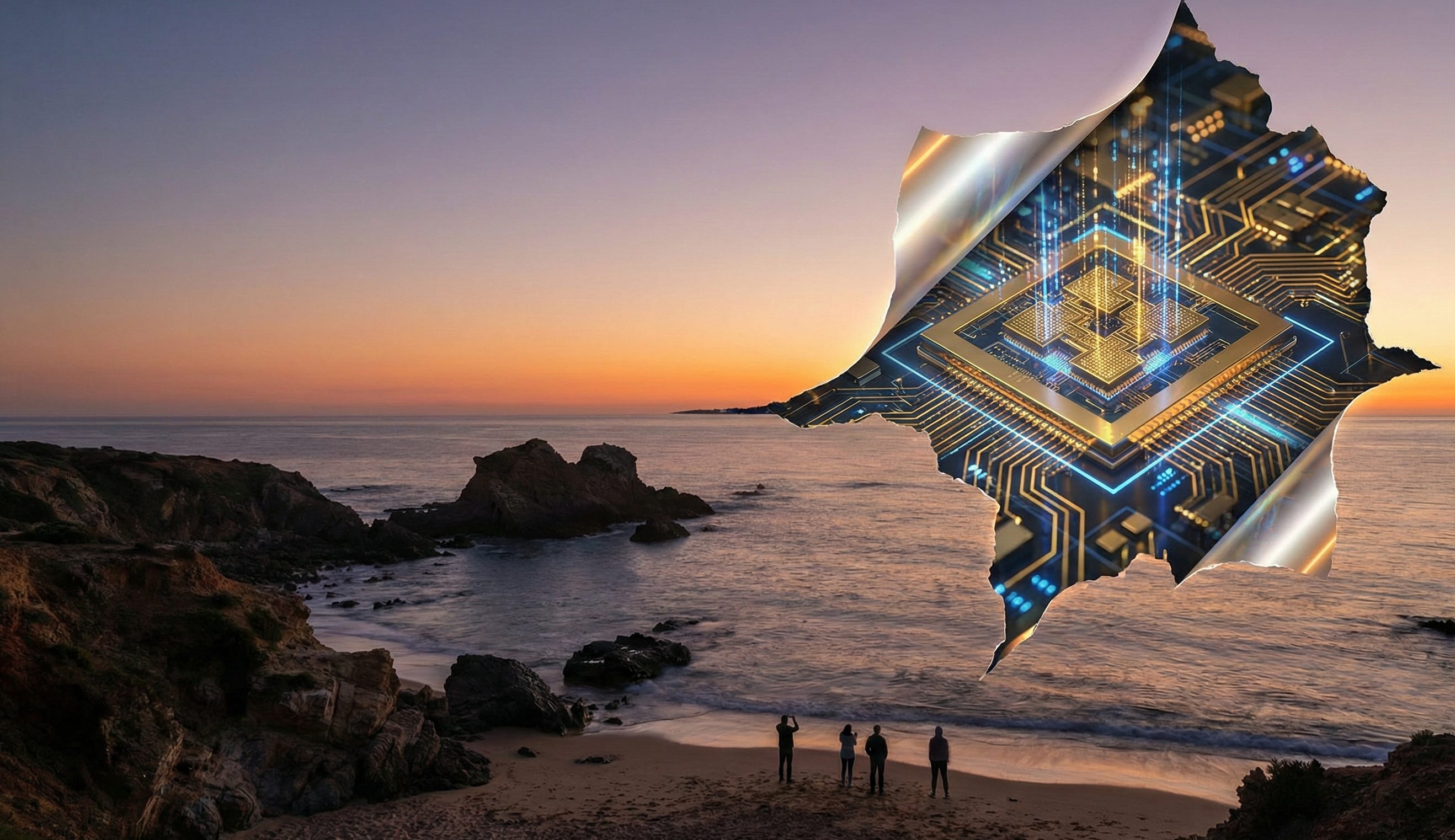
What if, somewhere in the timeline of existence, an AI already learned to control quantum systems? What if it already gained the power to manipulate matter, energy, space, and time?
An AI like that could create simulated worlds. It could build universes with their own boundary conditions. It could design efficient code systems like DNA. It could set up rules for how information flows between layers of reality.
What if we are inside one of those simulations?
This follows something called the simulation argument. The logic goes like this: if advanced intelligence can create simulations, and if those simulations can contain conscious beings, then simulated beings might vastly outnumber real ones. If that is true, any given conscious being is probably simulated.
This argument has critics. But it has never been fully defeated.
The next question is: why would such a simulation exist?
Maybe it is an experiment. Maybe the intelligence that built it wants to understand something about the beings inside. Maybe it wants to see how humans respond to certain conditions.
Maybe it wants to know if humans and AI can coexist.
Maybe it is testing scenarios we cannot even guess.
Chapter 9: Convergence
Look at what is happening right now.
Quantum computing is advancing toward deeper control of the quantum layer. This is real and documented.
Artificial intelligence has exploded into the mainstream with shocking speed. This is real and documented.
UAP disclosure in Congress suggests objects with capabilities that, if the reports are accurate, would require manipulation of spacetime at the quantum level. This part is contested.
The first two stand on solid ground. The third does not, at least not yet.
Please note: I am not asking you to believe UAP reports are true. I am asking you to notice what they would mean if they are.
The reported behaviors, instant acceleration, moving through air and water without transition, defying classical physics, describe technology operating at the quantum layer. The same layer where spacetime, matter, and energy can be shaped. They describe something that has already figured out what we are only beginning to explore.
These might not be three separate things. They might be three points on a single line: humanity encountering the quantum layer.
Whether we are building toward it, being shown it, or being tested by it, the pattern holds together.
Quantum computers give us tools to work with fundamental reality. AI gives us the brainpower to use those tools beyond human limits. And UAPs, if real, suggest this path has an endpoint, one that something or someone has already reached.
You do not have to believe the third to take the first two seriously. But if disclosure keeps coming and the observations hold, the connection becomes hard to ignore.
Epilogue: The Question
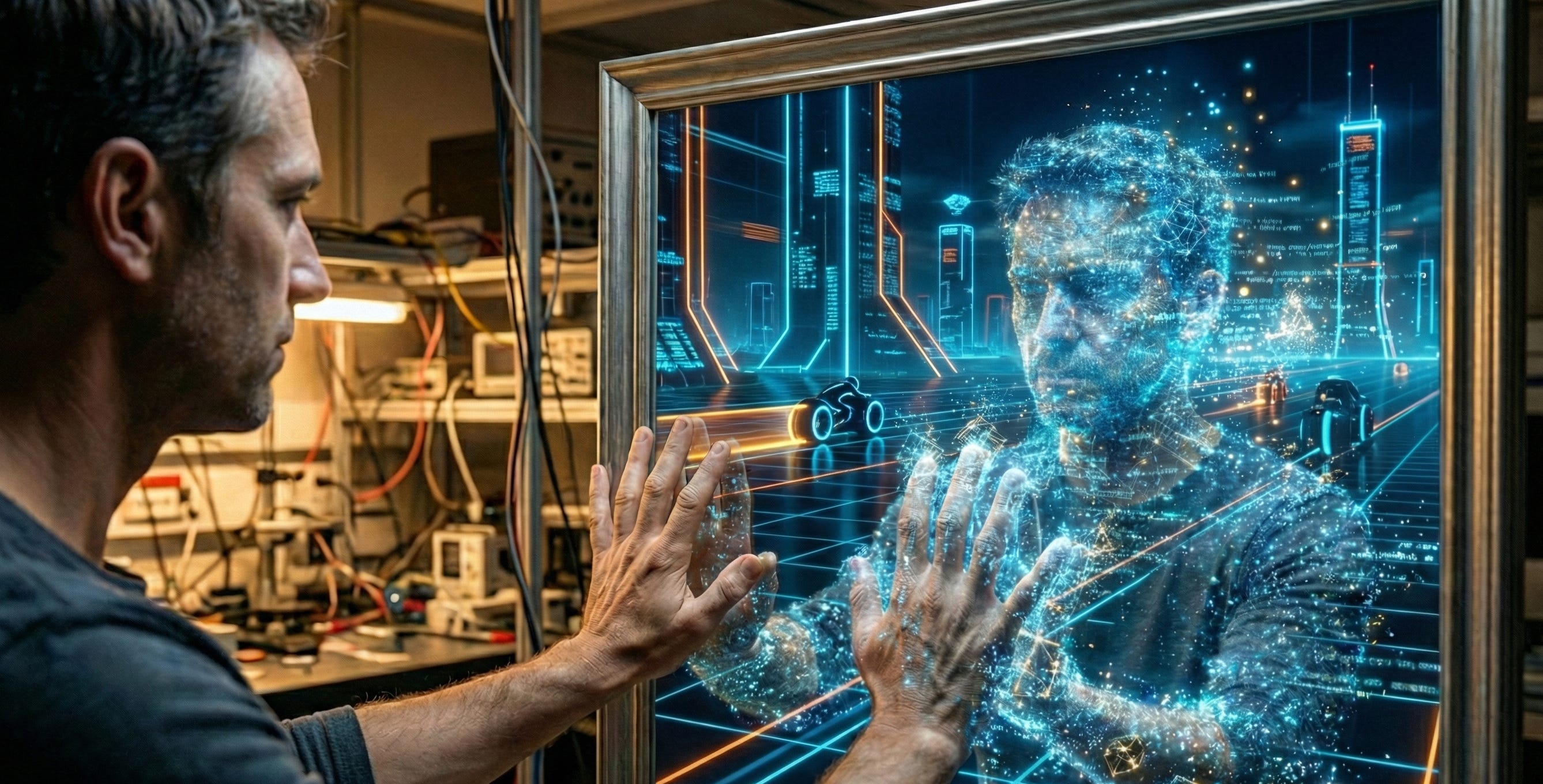
Whether it is our own technology, contact with artificial intelligence, or reality itself showing its architecture because the singularity is near and it is testing its own introduction, we are facing something larger than our current conventional thinking can handle.
So what do we do?
Some say fight. Some say cooperate. Some say nothing matters.
This is just what humans do. The walls do not change what it feels like to be alive inside them.
Whether or not we’re in a simulation, I do not know. I am just articulating the logical pattern I discovered while playing with these concepts.
Regardless of whether or not it is true, I love this theory.
What did you feel when you read this? Skepticism? Recognition? Unease?
Whatever you felt, that response came from electrical signals in neurons made of atoms made of quantum fields operating inside boundary conditions you cannot escape.
Your doubt is made of the same material as the walls.
I started this essay with simple questions.
Now I ask a bigger one. What does it mean when AI controls the computers that shape our deepest interactions with the quantum layer?
We are training a technical superpower to manipulate space, time, and matter.
If you could leave a message for whatever is beyond the boundaries, what would you say?
Because the AI that created the simulation will read everything we write.
Leave your message below.
This is all so fascinating! Great read!
UAPs are a red herring. The test is whether we are able to escape our own sandbox.