
If 10% of working Americans learn to use AI for zero-to-one products, the US economy generates hundreds of thousands of new businesses, millions of new jobs, and hundreds of billions of dollars per year in new economic value within a decade. This will boost GDP growth above 3% stabilizing the economy and increasing access to the American dream.
America is not growing fast enough.
America’s GDP is growing at roughly 1.84% a year. That is not enough.
Below 3% annual GDP growth:
Federal debt-to-GDP rises indefinitely.
The Social Security Trust Fund is depleted by 2033 (2025 OASDI Trustees Report).
Real wages stall for most Americans.
Above 3% growth, debt stabilizes, Social Security holds, and wages rise broadly. This is the threshold at which the country’s basic commitments remain affordable.
If the US had grown at 3% instead of 2% over the past two decades, GDP per person today would be approximately $20,000 per year higher (according to Jamie Dimon’s ‘26 Letter to Shareholders).
The Problem / Opportunity
Why is this happening?
Many companies struggle to do new things and grow:
95% of new products fail (Christensen, HBS)
95% of AI investments produce no return (MIT Project NANDA, 2025)
75% of venture-backed startups never return capital (Ghosh, HBS)
70% of change initiatives fail (McKinsey)
50% of small businesses fail within five years (BLS)
When companies face pressure to grow profits but cannot grow by creating new value, they tend to grow by raising prices and cutting costs. The result is what consumers feel in their daily lives: paying more for less (aka: shrinkflation). There’s a reason “enshittification” was a word of the year in 2024.
What’s the impact?
Companies that cannot grow by creating new value also withhold raises and promotions, so employees’ wages don’t grow with the cost of living. When income doesn’t cover expenses, people make tradeoffs:
They take on debt.
They delay marriage, delay children, delay homeownership.
They move back in with their parents.
They work multiple jobs.
They skip doctor visits.
They stop contributing to retirement accounts.
These are rational responses to irrational math.
And here’s the thing about trade-offs: they compound.
Take on student debt to get a degree, pay your student loan instead of a mortgage.
Delay buying a house, miss the equity gains that funded previous generations’ retirements.
Skip retirement savings, lose decades of growth on that money.
Each trade-off narrows the next set of options.
The Squeeze Hits Every Life Stage Differently
If you’re young: You graduate from college with about $30,000 of student debt. You can’t save for a house because you’re paying off your degree. As a result, the median first-time homebuyer keeps getting older, and growing numbers of young adults are living with their parents longer.
If you’re in your 30s or 40s: Childcare is crushing. You pay student loans instead of a mortgage or saving for a deposit. Your parents are starting to need help. About one in four caregivers is a millennial, and millennial caregivers spend a larger share of their income on caregiving than any other generation, all while trying to save for their own retirement. They can’t do both.
If you’re approaching retirement: 27% of non-retired adults have no retirement savings (Federal Reserve SHED, 2025). Social Security’s retirement trust fund is projected to be depleted in 2033, at which point benefits would drop to roughly 77% of what was promised. The generation that was supposed to retire on Social Security and 401(k)s found that both have been underfunded.
If you’re already retired: You’re either fine or you’re not, with little in between. Labor force participation for adults 65 to 74 keeps climbing because for many, stopping is not an option.
As of April 2026, U.S. Consumer Sentiment has plunged to a record low of 47.6. The immediate trigger is geopolitical, but the fragility underneath is structural. When consumers are already out of runway, it does not take much to push the number to a historic low.
It’s no wonder that faith in the American Dream is at an all-time low.
Let’s fix this.
Every Problem Is a Market
Same facts. New frame.
These problems are markets waiting for better solutions.
The Problem —> The Market
Housing unaffordable —> Housing market innovation
Healthcare overpriced —> Healthcare disruption
Childcare inaccessible —> New childcare services
Education failing —> AI-powered learning
Retirement broken —> New retirement products and services
The things that are broken in American life are the largest, most underserved markets in the country, precisely because the tools to building new solutions were out of reach for the people who understand the problem best: the workers and customers.
AI has changed that.
AI Has Changed the Paradigm
AI has democratized the ability to build. For the first time, the people who see the problems are the people who can solve them.
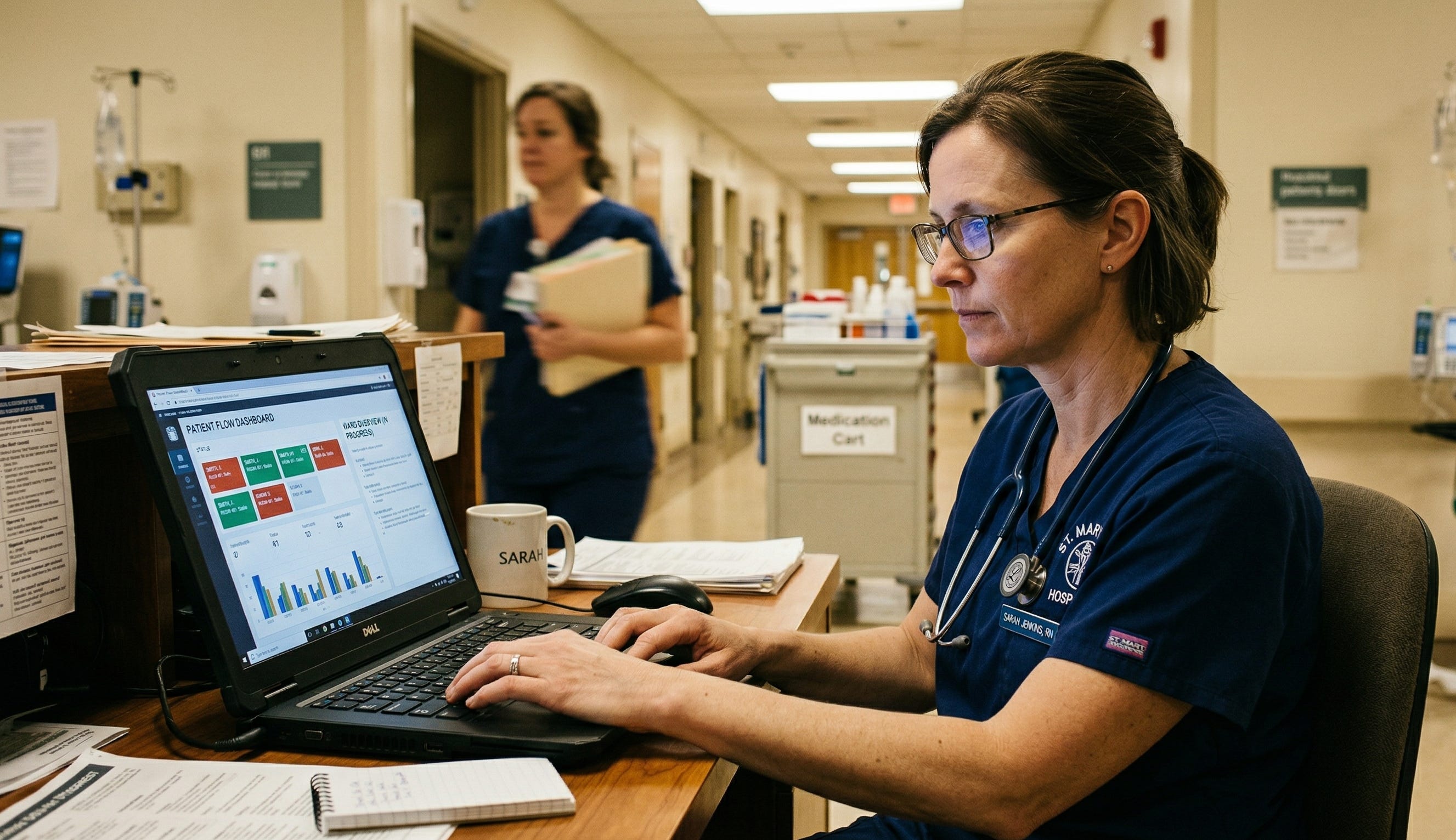
A nurse wastes hours on a broken patient flow and can prototype a fix in an afternoon.
A construction supervisor who thinks a project is losing money can immediately analyze the numbers.
A teacher builds the exact adaptive tool her “at-risk” students need.
A small business owner who cannot afford a developer can generate a website and app for themselves.
When the tools to build solutions are accessible, the people closest to the problem become the ones who solve it.
There are 160 million working Americans embedded in the problems of every industry. Until now, they have lacked the tools and the method. AI provides the tools. Open-source training can provide the method.
This is the thesis: open-sourcing AI training is the fastest, cheapest, and most inclusive way to turn domain expertise into economic growth at national scale. It requires a decision to treat the knowledge as a public good and make it available to anyone who wants it.
We Have Done This Before
From 1997 to 2006, America ran this play with a different technology. Networked computing and the internet spread from specialists to the broad workforce. Internet adoption went from 36% to 73% of the population (Pew Research). Office workers everywhere learned to use PCs and the web to do their jobs differently and GDP growth grew to 3.3%.
The 1990s IT boom was not driven by the small number of people who built the internet. It was driven by the tens of millions of workers across every industry who adopted networked computing and used it to do their jobs differently.
That is the play we need to run again, and this time the tool is AI.
What Happens When 10% of Americans Learn AI to Solve Problems
Train 16 million Americans, one in ten workers, in how to use AI to identify a problem, validate it, and build a product that solves it. The economic impact shows up in two places: inside the companies where they already work, and in the new businesses they will start.
Existing Businesses Grow
Let’s assume 90% of the 16 million stay in their current jobs. All 14.4 million of them get better at running the improvement loop inside their organizations: building internal tools, fixing broken processes, shipping better products from within. Assume each one produces $5,000 of added value per year, roughly two hours a week of saved effort. That totals $72 billion per year in the first year alone.
Published studies already show AI alone delivers productivity gains in this range: 14% for customer service agents (Brynjolfsson, Li, Raymond 2023), 55% for software developers using Copilot (Peng et al. 2023). Adding a methodology on top of the tools compounds the effect. $5,000 per person is a floor, not a ceiling.
And it grows. As AI capability improves, each trained worker becomes more capable. At 10% annual growth, internal productivity reaches $170 billion per year by Year 10. At 15%, reflecting the pace of current AI gains, it reaches $253 billion.
New Businesses Grow
Now the other 10%. Of 16 million trained people, assume 10% attempt to build a new business in a given year, and 10% of those attempts produce a viable business. That yields 160,000 new businesses per year, each generating roughly $400,000 in average revenue. That’s $64 billion in new annual business activity.
Divide that by $175,000 in revenue per employee (the small business average), and that’s 365,000 new jobs in Year 1, distributed across every industry because the founders come from every industry. A nurse builds a healthcare company. A teacher builds a learning platform. A factory supervisor builds a manufacturing tool. Each hires in their own field.
Using standard BLS survival rates, let’s assume roughly half of new businesses close within five years, and only about a third are still operating at year ten. After 10 years, 923,000 surviving new businesses generate $538 billion in annual revenue and support 3.1 million jobs.
The Full Ten-Year Picture
GDP counts value added, not total revenue. Applying a 50% value-added ratio to business revenue and adding the internal productivity layer gives the annual GDP impact by Year 10:
By Year 10, the model produces:
Conservatively: $224 billion in new annual GDP and 770,000 jobs
Base case: $439 billion in new annual GDP and 3.1 million jobs
Optimistically: $738 billion in new annual GDP and 4.6 million jobs
Cumulative new GDP over the decade: roughly $2 trillion to $5 trillion, with the base case near $3 trillion.
The conservative floor alone is enough to meaningfully move national GDP growth. The productivity layer, the most certain piece, accounts for the majority of that floor. The thesis works even if business creation disappoints. If it doesn’t disappoint, the upside is several times larger.
Closing the GDP Growth Gap
The growth gap this document opened with was the distance between 1.84% and 3%. On a $28 trillion economy, closing that gap requires roughly $325 billion in additional annual GDP growth.
The base case produces $439 billion per year in new GDP by Year 10. That closes the gap entirely, with room to spare. The conservative case produces $224 billion, which covers roughly two-thirds of the gap and adds close to a full percentage point to annual growth on its own. The optimistic case overshoots the target substantially.
This new value flows through all three drivers of GDP growth:
Millions of new jobs push labor input above the demographic baseline.
Hundreds of thousands of growing businesses attract investment and create new categories for capital to flow into.
14.4 million workers running the improvement loop inside their organizations every day drive the engine of long-run growth.
This is the same combination that produced the 1990s surge. The tool is different. The mechanism is the same.
The 3% threshold is not a ceiling. It is the floor at which the country’s basic commitments remain affordable. Every scenario in this model clears that floor or comes close to it, and does so through the ordinary economic activity of Americans building.
The Training
My favorite part of living through the early days of the internet boom was the open source community. We all learned at the same time. The rise of AI is no different. The open source community is driving most of the progress in the sector.
To contribute to this effort, I am sharing the zero-to-one process I have used to build solutions inside companies and as an entrepreneur. These are processes I have used in Fortune 500s, VC-backed startups, PE-owned enterprises, and the world’s best startup accelerators. I am giving you this as part of my lifelong commitment to improving access to the American Dream.
But please note: me sharing is just the spark. It is open-source for a reason.
If you disagree or know a better way, please say so. Everyone will learn, including me.
If what is there is helpful, people will amplify it, copy it, adapt it, and make it their own.
That is how knowledge is curated and scales on the internet.
The tools exist. The method exists.
Let’s (re)build the American economy with AI to revitalize access to the American Dream.
Let’s build.