

With AI, most businesses are twenty years behind the present. Thankfully, AI has made it easier than ever for everyone to evolve their business, catch up, and get ahead.
If the business I’m about to describe sounds far fetched, it’s not. This is how Amazon ran when I worked there in 2007: pre-AI.
The Business That Already Lives Here
It is Tuesday morning. Suzy, a mid-market CEO opens her laptop and reads three things before her coffee is cool.
What happened overnight.
Pricing adjusted on eleven SKUs after a competitor move hit the data at 2 a.m.
Inventory rebalanced across three DCs as weather shifted demand in the Southeast.
A support subroutine resolved four hundred tickets without a human, and flagged six that needed one.
She did not approve any of this. She set the goals, guardrails, and escalation conditions. The loops did the rest.
What opportunities opened up.
For her morning read, her AI scanned all emails, chats, and inbound documents to identify three opportunities that align with her current priorities:
A new channel competitors have not touched.
A technology shift that compresses her supply chain by a week.
A customer segment signaling demand for a product she does not yet sell.
Each comes with recommended next steps, a clear owner, and potential questions. She approves two to move to the next steps and asks the third for more information.
What her team is working on, and the inputs driving it.
She has real time visibility into the inputs her team is actually using: selection, price, speed, quality, experience - all powered by technology with excellent telemetry. These are the levers that cause scalable outputs in business. Outputs are growth in revenue, margin, and retention and reduction in costs.
Where the loops are running well, she lets them run. When they are not, she can read it in the inputs and intervene before it impacts the outputs.
Her competitors are still waiting for the PowerPoint with the monthly numbers.
They are still debating output metrics they cannot clearly define, let alone control. They are running nineteenth century management techniques at a twentieth century slide deck rhythm against a twenty first century atomic clock.
It is 2026. They did not jump on machine learning in 2010. They woke up to AI when ChatGPT launched. They are so far behind that she does not have to worry about them. She keeps her eyes on her customer and on the horizon, watching for her actual competition: the AI native companies that will endure and thrive.
This is not a vision of 2040. It is how a growing number of businesses operate right now. It is also, not coincidentally, how Amazon operated in 2007.
Explaining Business to Computers
To run your business like Suzy, you need to be able to explain it to a computer. To make computers understand business, we have to simplify it for them.
I’ve spent the better part of three decades helping computers operate businesses in many sectors: law, investing, books, ecommerce, payments, physical retail, digital media, advertising, marketplaces, education, and web services.
What I’ve learned from building technology that runs businesses.
Businesses sell solutions.
Solutions are made up of some or part of brands, design, distribution, experiences, management, manufacturing, products, services, technology, and many other potential inclusions.
To build and change solutions, businesses use a few tools:
Innovation is the creation of new solutions. Going from zero to one.
Iteration is making a solution incrementally better, going from version 1 to version 2, 3, 4, and onward.
Transformation is overhauling a solution to make it fundamentally perform differently, ideally making the solution measurably more efficient and effective than before.
These activities were always thought of as projects.
They have a start date and an end date.
They are scheduled months in advance through rigorous, continuous planning cycles and project management.
Budgets were allocated for the discrete, time-bound activities.
The decisions we make, and the data we use to make those decisions, are more critical than ever.
AI changes all of this.
AI changes faster than any technology in history. It is being adapted and adopted faster than any technology in history. And there is more money being invested in AI capabilities than into any other single technology in the history of our species. Things are very different, right now.
It is time to adapt. That starts with learning where you are. The better we understand our own businesses, the more precisely we can start to build the cybernetic loops we need in our business to ensure that we are thriving in the era of AI.
The decisions we make, and the data we use to make those decisions, are more critical than ever. We must learn to encode them into our own cybernetic loops.
This is how we will maximize the application of AI in our job, company, and industries.
The Cybernetic Loop
This is not a metaphor. This is the actual structure of what your business does.
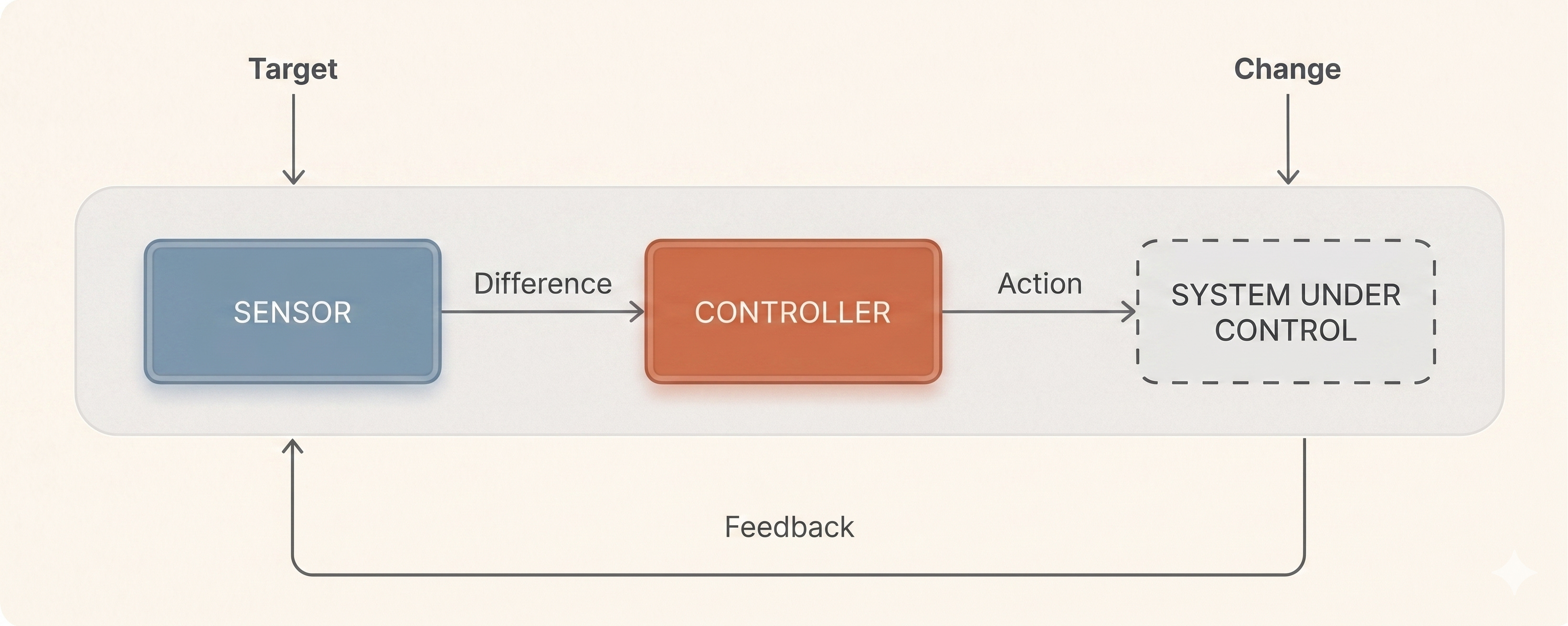
Note: The cybernetic control system serves to keep the system between acceptable operating limits (ex. constraints, performance levels, etc).
Every subroutine in your business runs on the same loop.
Target = Your goal
Sensor = Your Current Performance
Difference = Gap between Our Goal and Performance
Controller = Your Options, choose one or many.
Action = Execute the Chosen Option(s)
System Under Control = The solution you’re changing
Change = The outcome of your inputs
Feedback = Measure Results from the Action
This is a continuous loop. The speed at which the loop closes and repeats is the variable that determines whether you pull ahead or fall behind.
Cybernetic Control System & Decision Frameworks
We use the cybernetic loop as our foundational process as it aligns with all successful business improvement and innovation decision frameworks. Every framework you have ever used is a variant of the same loop.
You already know this pattern. You have just been running it slowly and in pieces.
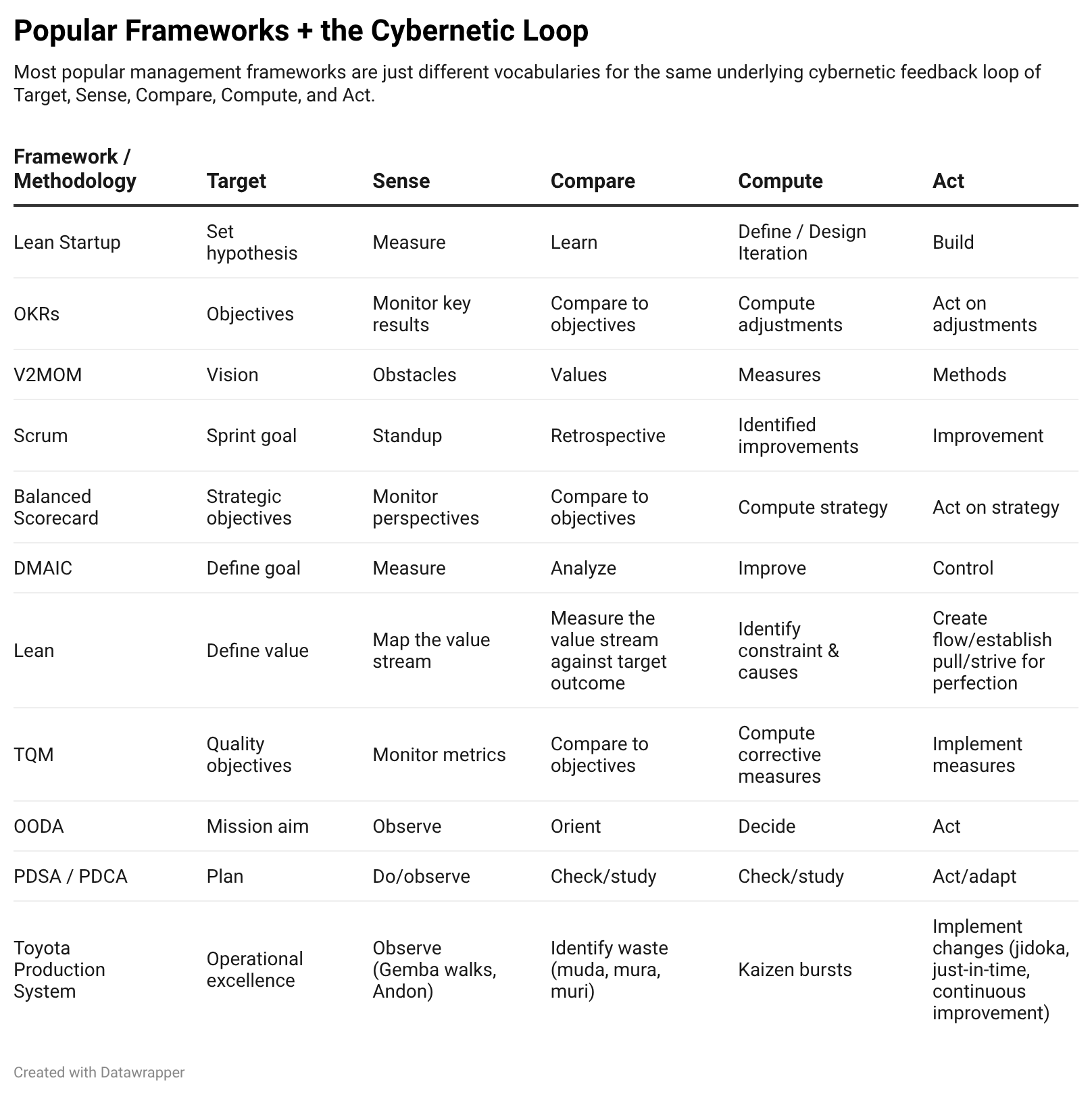
Table Source: Pereira, Steve, and Andrew Davis. Flow Engineering: From Value Stream Mapping to Effective Action. IT Revolution Press, 2024, p. 27.
Every framework in this table was designed for loops that close in weeks or quarters. AI closes them in seconds. The frameworks are not wrong. The manual processes underneath them are. They were built for a physics that no longer applies.
The work ahead for most businesses is to accelerate these loops as fast as possible. The rest of this piece and the next several articles I am sharing will show you how.
Cybernetics and Business Management
The more precisely you understand your subroutines and the more specifically you can name the impact each one has on your customer, your sales, your profit, and your growth... the more you are connecting your inputs to your outputs.
This is when your judgment compounds. You begin to trust which investments will produce which outcomes. From there, you can pursue the priorities that matter most at scale, over time, with real confidence.
Once you can see one part of your business accelerating, you begin to reinvest in accelerating other areas. This is how, over time, you consistently adapt and evolve your business to the rhythm and cadence of AI.
That’s how you build the confidence to consistently invest tens of millions of dollars in technical innovation every year and build the future.
What Goes Into the Loop, and What Comes Out
Every cybernetic loop in your business runs on the same four inputs and produces results against the same four outputs. And every decision inside the loop draws from the same six data clusters. Once you see this, you can audit any subroutine in your business and know exactly what it needs to operate.
The Four Inputs
These are the raw materials every loop requires. Starve any one of them and the loop slows down or breaks.
Team (Culture). The people and the shared beliefs that govern how decisions actually get made. Culture determines whether your people trust the data, trust each other, and act decisively when the loop calls for action. AI does not replace this input, it amplifies whatever culture you already have.
Technology. The sensors, the compute, the models, the systems of record, the interfaces. In the AI era, technology is the input that has changed most dramatically, which is why so many businesses are out of balance. They have twenty-first century technology feeding twentieth-century processes managed by teams trained for a pre-AI world.
Process. The repeatable sequence by which sensing becomes action. Your business processes are the choreography that turns data into outcomes. Bad process means good data produces nothing.
Data. The fuel. Without real-time, high-quality, well-structured data, the loop has nothing to sense, compare, or act on. Most businesses have oceans of data and drink from it through a straw. The shift to AI requires treating data as a first-class asset on par with capital.
The Four Outputs
These are what the loop produces when it runs well. Every subroutine in your business ultimately contributes to one or more of these.
Grow revenue. New customers, larger deals, higher retention, better pricing, new markets, new products. The loop finds growth and compounds it.
Decrease costs. Waste eliminated, processes automated, resources reallocated, errors prevented. The loop finds friction and removes it.
Deepen customer relationships. Faster response, better personalization, higher trust, stronger loyalty. The loop turns transactions into relationships and relationships into moats.
Develop new solutions. Innovation, iteration, transformation. The loop does not just optimize what exists, it creates what does not yet exist.
A healthy business runs loops that produce all four outputs simultaneously. A business that only optimizes for cost eventually stops growing. A business that only chases revenue eventually collapses under its cost base. The loop, run well, balances all four.
The Six Data Clusters
Every decision inside the loop draws on some combination of these six data clusters.
Customer. Who they are, what they want, how they behave, what they pay, what they leave for, what they tell others.
Competition. Who you are up against, what they are doing, where they are stronger, where they are weaker, what they are about to try.
Company. Your own internal reality. Financials, operations, people, systems, pipeline, performance.
Context. The environment around you. Market, regulation, macroeconomics, technology shifts, cultural changes, geopolitical factors.
Capital. What you have to deploy. Cash, credit, talent, time, attention, brand equity, strategic relationships.
Self. The leader’s own clarity, conviction, capability, and capacity. The most underrated data cluster. The loop runs through you.
What to Understand for Each Cluster
For every one of the six clusters, you need clarity on six dimensions.
Costs. What does it cost to acquire, maintain, and act on data in this cluster.
Data. What you actually have, where it lives, how clean it is, how fast you can access it.
Decision making. Who decides, how they decide, how fast they decide, what authority they have.
Motivations. Why the actors in this cluster do what they do. Customers, competitors, employees, partners, regulators, yourself.
Processes. The repeatable sequences that govern how this cluster behaves and how you interact with it.
Timelines. The rhythm. Daily, weekly, quarterly, multi-year. Each cluster has its own clock.
Why This Matters
When you can name your inputs, name your outputs, and map your data clusters across these six dimensions, you have a complete picture of what your business needs to operate. You know what to instrument, what to automate, what to hand to AI, and what to keep with humans. You know which loops are starved and which are well-fed. You know where to invest next.
Over the coming months, I’m going to be sharing the questions you need to ask yourself, your team, and AI to ensure that you develop your business for the era of AI.
Most businesses cannot answer these questions clearly for even one subroutine. The businesses that can, for every subroutine, are the ones that will run at 99.999% and maximize the potential and promise of AI in their business.
Those that do not, or those that fall too far behind, will be lost to time.
Your team plus AI can do this.
If you’re a leader, this week I’d recommend asking your teams and yourself a few questions:
Which of your subroutines are still running on quarterly PowerPoint loops?
How much risk is embedded in the assumption that they always will be?
What would your business look like if you closed that loop in hours instead of quarters?
Forward this to the person who owns that subroutine and offer to help.