Business Evolution: The Canonical Doctrine
Continuous Growth Through Knowledge and Discipline, Accelerated by AI

A Note to the Builders
This is the best time in a generation to make an impact in business.
America needs more good jobs. To create jobs, companies must grow. For companies to grow, businesses must give customers lower prices, higher quality, and better value.
To thrive, business leaders must provide investors with something that has been missing for more than a decade: durable growth built on supply chains we actually control.
This means there are enormous opportunities available to those who want to make an impact. Concurrently, three forces are driving economic change not seen since WWII:
AI lets companies grow revenue without growing headcount
The American economy is rapidly reshoring and re-industrializing
The global economy and trade agreements are restructuring
These forces will reshape nearly every foundational sector:
Care: Childcare, Education, Eldercare, Healthcare
Critical Infrastructure: Energy, Food, Housing, Manufacturing, Transportation, Water
Financial Systems: Currency, Investing, Insurance
National Security: Defense, Space, Shipbuilding, Semiconductors
Media: News, Social Platforms, Streaming, Studios
Together, these sectors represent over $20 trillion in annual economic activity. What lies ahead is the largest wealth transfer in generations.
Historically, transformations like this belonged to enterprises. But large companies are constrained by legacy incentives and structures.
This opportunity is a call to builders: the entrepreneurs, executives, operators, and people who see the opportunity and feel compelled to capture it. The leverage has shifted. AI has democratized the ability to execute big strategies, allowing small, disciplined teams to do what used to require Fortune 50 resources.
The markets are massive. The customers are waiting. The technology is ready.
The only remaining variable is execution. And that’s where most people fail.
The Problem
The American economy has the most innovative businesses. However, when it comes to doing new things, most businesses still fail:
95% of enterprise AI pilots fail to deliver (Source: MIT)
95% of new products fail (Source: Clayton Christensen at Harvard)
75% of VC-backed startups fail to return capital to investors (Source: Harvard)
70% of organizational transformations fail (Source: McKinsey)
50% of new businesses fail within 5 years (Source: BLS)
These failure rates make many executives reluctant to swing big.
Because successful execution is so rare, the few companies that get it right capture nearly all the value. This is creating a winner-take-all economy. As a result, the top 1% of companies now control 80% of the assets and income in their sectors. (Source: Harvard/UChicago/Leibniz).
This concentration slows job growth, reduces competition, and raises prices.
By improving our rate of success, we could rapidly grow the economy. In 2024, US businesses spent over $2 trillion on failed initiatives. That’s 5% of US GDP that could be redirected to growth.
Most organizations do not fail because they lack ambition, effort, or tools. They fail because they make high-stakes decisions without a shared, current, and evidence-based understanding of their own business.
Information exists, but it is fragmented across systems, teams, and time. Assumptions linger long after reality has changed. Decisions are made quickly, but from different mental models of what is true. AI accelerates this problem by allowing teams to act faster without correcting the underlying gaps in understanding.
Business Evolution exists to close that gap.
The Solution
The barrier to entry for elite strategy has collapsed.
In my career leading innovation at Amazon, PayPal, Target, and Visa, generating the data required to support multi-year, multi-million-dollar investment decisions typically required a team of 10 to 15 experts, more than 12 weeks of work, and over $500,000 in internal time and/or consulting costs.
Today, that barrier is gone.
What used to cost hundreds of thousands of dollars and months of time now takes days with Business Evolution:
Enterprises can use AI to recapture the speed and hunger of a startup.
Startups can use AI to wield the discipline and scale of a Fortune 50.
Business Evolution helps leaders make the right decisions early, before you spend money, hire teams, or risk your reputation. It:
Gives you the questions that Fortune 50 boards, top CEOs, and VCs ask
Structures the research so you answer them with data, not opinions
Uses AI to compress what used to take months and $500K+ into days
Builds credibility before you spend real time and money
Works backwards from the customer to validate viability
I have encoded the strategic rigor of the best startups and Fortune 50s into a deployable AI operating system that establishes and maintains the foundational knowledge every serious business decision depends on, including:
who the customer actually is and what problem they are trying to solve
how the business really makes money and under what constraints
what the culture can and cannot execute
how the market and competitive landscape are changing
how the above context informs what your business is capable of reliably executing
Once established, the same foundational knowledge supports every high-stakes decision an organization makes.
This knowledge is not static. It must be continuously refreshed, challenged, and updated as conditions change. That is why Business Evolution is a discipline, not a one-time exercise.
The absence of this foundation of knowledge becomes most visible when organizations try to do something new: deploy AI, innovate, transform, iterate, and build new solutions.
Most often, these are expensive, public, and irreversible investments. Leaders need to get them right. Before committing, every hidden assumption must be surfaced and alignment achieved between leaders, investors, and customers.
In an AI-accelerated world, execution is cheap and mistakes scale instantly. The scarce resource is no longer speed. It is judgment.
Business Evolution exists to make judgment systematic, disciplined, and grounded in reality, so organizations can grow continuously instead of relearning the same lessons at increasing cost.
It replaces the “guessing game” of innovation with a decision engine. By combining proprietary AI frameworks with structured diligence, you simulate the board-level scrutiny of a major enterprise—in days, not months. This gives you the confidence you need to invest in strategic initiatives in your business.
The 5 Foundational Questions
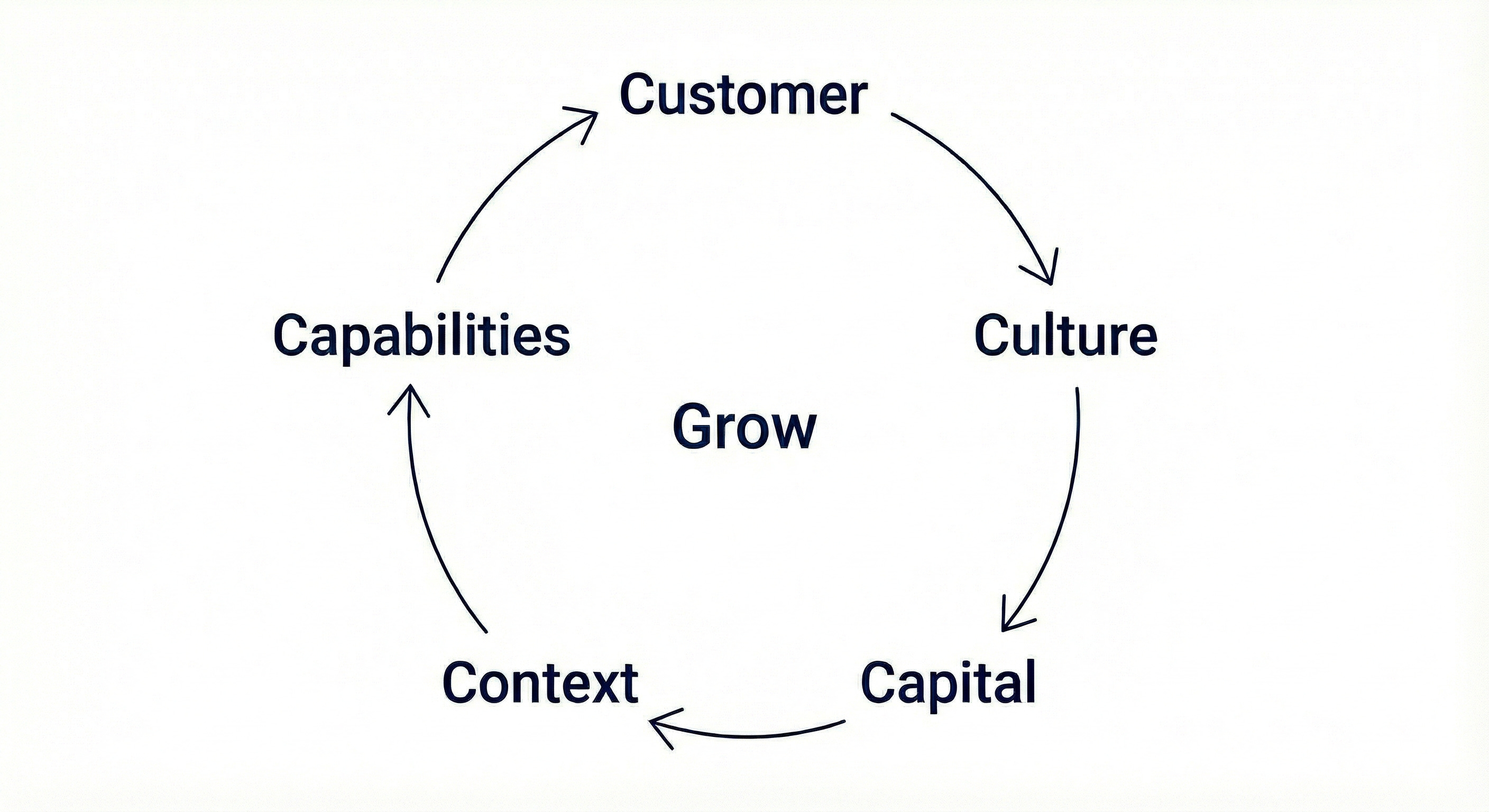
Before you invest in anything, you need answers to five categories of questions about your Customer, Culture, Capital, Context, and Capabilities. Each one informs the next. Everything else - innovation, transformation, iteration, experimentation, integration, synergies, growth, scaling, profit - follows.
You have limited money. You have limited time. You cannot do everything. So you must choose carefully what to invest in.
Working backwards from the customer using data ensures you maximize the chance of investing your limited dollars and time into the focused opportunities that will deliver the greatest benefit to your company, customer, and investor.
Answering these questions will give you the foundational information you need to build the confidence required to invest millions of dollars into new solutions.
To survive in the AI era, your business needs to rapidly execute. The answers to these questions will give you the foundational information you need to effectively accelerate your business.
Why the Sequence Matters
The Business Evolution framework imposes sequencing discipline on strategic inquiry.
Customer first ensures outside-in orientation and prevents solution-looking-for-a-problem thinking.
Culture second ensures execution capability before strategy development.
Capital third ensures you can afford to build what the customer wants.
Context fourth ensures you understand what you are doing before you analyze potential competitors and markets.
Capabilities fifth ensures you have the data required to perform an honest and accurate assessment of build-versus-buy-versus-partner options.
The failure statistics tell the story of what happens when companies skip these steps.
This is not a checklist where you pick your favorite. It is a sequence where each step depends on the answers from the previous step:
Think of building a business like building a house. You would not start by picking paint colors or buying furniture. You would start by asking:
Who is going to live here? What do they want and need?
Then: Can my team build it?
Then: Do we have the budget?
Then: What are other builders doing in this neighborhood? Are prices going up or down in this location?
And finally: What tools and skills are required to actually construct it?
Skip any step, and you risk building something nobody wants, or something you cannot finish, or something that costs more than you have.
1. Customer
Who is your customer? What problem do they have? How do they describe it in their own words? What are they doing today to solve it? What does success look like in their words?
Customer comes first because everything flows from understanding the person you are trying to serve. Without this understanding, you are guessing. Guessing leads to building the wrong thing. Building the wrong thing wastes money, time, and reputation.
The best companies in the world start every strategy discussion with one question: What does the customer actually need? This discipline prevents what kills most new products: falling in love with a solution before validating the problem.
If you do not know what your customers want, you might build something nobody buys. Your product fails. Your investment is lost. Starting with the customer ensures you are solving a real problem that real people will pay to have solved.
To answer these questions, you need to run a process:
Step 1: Preliminary Research
Step 2: Qualitative Research
Step 3: Quantitative Research
Step 4: Determine Beachhead Customer
Step 5: Build Customer Personas
Step 6: Share What You Learned
2. Culture
If your team is not obsessing over the customer, the problem is not strategy, AI, or technology. It is culture.
Culture comes second because you cannot serve customers well if your team does not care about customers. Talented people naturally want to help customers. If your team is not focused on the customer, you have a culture problem, not a strategy problem. You must fix culture before you can fix anything else.
Culture is how your team thinks and acts every day. It is the habits, beliefs, and behaviors that shape every decision. Culture is invisible, but it controls everything.
Here is why: Every day, your team makes hundreds of small decisions.
Should we call this customer back?
Should we fix this bug first or that one?
Should we launch now or wait?
Each decision is shaped by culture. Add up thousands of decisions over time, and you get outcomes.
Culture determines how decisions are made. Decisions determine outcomes.
Once culture is aligned around the customer, something powerful happens: disciplined inquiry replaces opinion.
Instead of “I think customers want this,” your team says “The data shows customers want this. We talked to 50 of them. Here is what they said.”
Opinion leads to guessing. Disciplined inquiry leads to knowing. Knowing leads to focus.
AI accelerates analysis. AI can process data faster than any human. It can find patterns you would miss. But AI cannot tell you what matters most. That judgment comes from your team. And your team’s judgment is shaped by culture.
A team with a customer-obsessed culture will use AI to understand customers better. A team with a broken culture will use AI to make faster bad decisions. The tool is neutral. The culture determines the outcome.
To execute with AI, your team needs five cultural traits:
Growth Mindset: Willingness to relearn how to work as AI evolves
Continuous Learning: AI changes fast; your team must keep pace
Data-Driven Iteration: Instrument everything, optimize relentlessly
Resilience: Sustaining impact through constant change
Customer Obsession: Use AI to deeply understand and serve customers
If your culture resists learning, no strategy will save you. If your culture embraces it, AI becomes a multiplier.
3. Capital
Capital structure dictates strategy, not the other way around.
Capital comes third because once you understand your customer and have the right culture, you must ask: What are the rules of our financial game? Your money determines what strategies are even possible.
You cannot pursue a slow, steady growth plan if your investors need fast returns. You cannot pursue explosive growth if your investors need steady cash. Your capital sets the rules. If you try to ignore those rules, you will fail.
The mistake many companies make is playing by the rules of one game when they are actually in another. A startup chasing steady profits when it needs explosive growth will run out of runway. A mature company chasing explosive growth when it needs steady cash will destroy shareholder value.
What game are you playing? What are the rules? What ROI is required? What timeline are you on? Your answers determine which strategies are even possible.
There are three games, each with different rules:
Venture Capital: Bets on speed. Most investments will fail. The goal is for a few to grow huge, fast enough to make up for all the losses.
Private Equity: Bets on cash. The goal is to buy companies, make them run better, and pull money out quickly.
Public Markets: Bets on staying power. The goal is to own companies that keep winning year after year, decade after decade.
Match your strategy to your capital, or lose.
4. Context
Who else solves this problem? How well do they solve it? What do customers say about the alternatives? Where are the gaps? What trends affect this market? What is changing? What headwinds or tailwinds exist? Why is now the right time?
Context comes fourth because it ensures you understand the customer, your team’s ability to deliver, and your resources before you start to define your competitive positioning and market timing. You cannot assess the outside world until you have assessed your inside world first.
Many companies make the mistake of studying competitors before understanding themselves. They see what others are doing and copy it, without asking whether it fits their customer, culture, or capital. That leads to me-too strategies that fail because they are not grounded in the company’s own reality.
Before you study the competition, you need to know three things. First, what problem are you solving and for whom? That is your customer. Second, can your team actually deliver? That is your culture. Third, do you have the resources to execute? That is your capital.
Only after you answer those three questions does it make sense to look outward. Now you can ask meaningful questions: Who else is in this market? How do they compare? Where are the gaps? What is changing? Why is now the right time?
Context is where you finally turn your attention to the external world, but you do so with a clear internal foundation.
5. Capabilities
Can you build this? Do you have the team? Capital? Customer? What is the gap? Should you buy? Or Partner? Who can you hire that has solved this problem before that you can learn from?
Capabilities comes last because this question is only relevant once you have validated the opportunity through the first four steps. Many companies fail because they skip straight to capabilities without answering the foundational questions. They ask “Can we build it?” before asking “Should we build it?” or “Why and for whom?”
Once you know your customer, have the right culture, understand your capital rules, and have mapped the competitive context, you can honestly assess what you can actually build, buy, or partner to deliver. This is where you identify gaps and figure out what you need to hire, acquire, or develop.
If you ask this question first, you risk building something you are capable of building but that nobody needs. If you ask it last, you ensure that your capabilities assessment is focused on validated opportunities.
The root cause of failure is the same: people rush to building before answering the foundational questions. They skip customer. They skip culture. They jump straight to capabilities. They build the wrong thing, for the wrong reasons, with the wrong team, and/or at the wrong time. And that results in failure.
The Virtuous Cycle
When you can answer these foundational questions with data, you unlock a self-reinforcing cycle that funds its own growth.
Working Backwards From the Customer Works
When companies follow this sequence, they build what customers actually need, with teams who care about serving those customers, using capital that matches their growth requirements, in markets where they can win, with capabilities that close the gap. The customer wins because the company is not guessing.
Starting with the customer ensures that every dollar and hour invested addresses validated demand rather than assumed demand. Data replaces intuition, reducing the risk of misallocation.
Here is how it works:
Deep understanding of the customer lets you make better decisions.
Better decisions help you grow revenue and decrease costs.
Revenue minus costs creates surplus capital.
Surplus capital gets invested into talent and technology.
Better talent and technology increase your ability to innovate, iterate, and transform.
Innovation, iteration, and transformation help you understand and serve your customer even better.
Repeat.
Each cycle strengthens the organization for the next. The advantage compounds over time.
How do you know if your team is making better decisions? You do not need to guess. The evidence shows up in two places: revenue growth and cost reduction. Surplus capital is proof that your team is making better decisions. It is proof that your culture is working.
Many companies take surplus capital and give it to shareholders or let it sit idle. The best companies reinvest it into the only two durable advantages a company can have: talent and technology.
Why these two? Because everything else can be copied. Your competitors can copy your product, marketing, and pricing. But they cannot easily copy your people and the technology systems you build over time. Talent and technology compound. They resist imitation. They create durable advantage.
Together, talent and technology determine your organization’s capacity to innovate, iterate, and transform again. And that capacity feeds back into the cycle. You understand customers better. You make better decisions. You generate more surplus. You invest again.
Innovation and transformation are activities. Evolution is the operating system that powers the continuous virtuous cycle.
Companies that innovate once and stop will be passed by companies that evolve continuously. Evolution is not a project with a start and end date. It is how you operate forever.
The Outcome
With these answers, you will know what to invest in, whether it is worth investing in, and how to talk about it with confidence.
You will then have what you need to walk into conversations with customers, investors, and team members prepared. They will sense it. They will trust you.
And you will have built the foundation for continuous evolution: not a one-time project, but an ongoing operating system that strengthens your company with every cycle.
The Bottom Line
AI changes the speed, not the rigor. The questions have not changed. Your ability to answer them fast is now the edge.
By answering these questions, you will have the evidence you need to make sound investment decisions at multi-million dollar scale.
Start with the questions. Apply your data, effort, and judgment. Build your credibility. Earn the right to invest. Then build something that creates impact.
If you are ready to practice Business Evolution, subscribe now. I will be sharing detailed documentation on every one of these topics: the processes, the research methods, and the frameworks that will help you answer the five questions with data.
FAQ
Why am I sharing Business Evolution?
For the last century, business education was modeled on the factory: standardized, theoretical, and slow. That model is broken.
In the AI era, we are returning to Apprenticeship. We learn by doing, sharing tradecraft, and leveraging each other’s data to evolve faster than the market. This is how Silicon Valley was originally created. This will be how AI evolves.
Therefore, this document is not meant to be a textbook. It is a transfer of tradecraft from me to you so that we can rebuild the American economy using AI.
What is the role of AI in evolution?
AI accelerates analysis. It does not replace your human judgment.
AI increases speed. It does not change your company’s reality.
Used improperly, AI allows organizations to scale the wrong ideas with false confidence. Used correctly, it reduces risk by surfacing assumptions, testing hypotheses, and improving decision quality before resources are committed.
To be successful with AI:
Think for yourself.
Test all assumptions.
Validate critical sources.
Keep humans in the loop.
Maintain secure data governance.
What are the definitions of the key terms?
Solutions: What customers buy to solve their problems (Brand, Experience, Product, Service, Technology).
Business: The discipline of profitably selling solutions.
Innovation: Creating new solutions (0 to 1).
Evolution: Continuously strengthening the system that delivers them (1 to ∞).
Companies that innovate once will be passed by companies that evolve continuously.
If you’re ready to practice Business Evolution, please follow me here as I will be sharing detailed documentation on every one of these topics.
The Business Evolution Doctrine
Version: 8.0. (Previous versions here)
Powered by HowDo
Created by West Stringfellow